Showing posts with label tomatoes. Show all posts

Sunday, March 4, 2018

Wakanda Forever

I saw Black Panther when it came out opening weekend a couple weeks ago. I loved it so much, I went and saw it the next weekend too. Aside from all the incredible and timely political and social messages of the movie, the film itself is visually stunning. It's nice to see Africa portrayed as more than just the savanna or the desert. The clothes, hair, and make up are just as stunning too. There was so much attention to detail, except for one area: food. The only food we see in the film is something that looks like chicken cooking on a grill, and plates of food at an outdoor cafe. None of the main characters ever eat or have a dining scene. As a foodie, I was sad that I had nothing to draw from to envision how people in Wakanda eat. Food is how I see the world and understand people and cultures, so, I decided to figure it out for myself!

The first step was to find where Wakanda is. According to the movie, it's on the eastern side of the central part of the continent, near Kenya, Uganda, South Sudan, and Ethiopia. I researched recipes from those countries and contemplated certain issues like, what sorts of ingredients do they use in Wakanda? New World ingredients like tomatoes, corn, and beans, are prominent in a lot of African recipes, but don't come from Africa. Because they come from the New World, they are a symbol of colonialism, which we know Wakanda was not subjected to. But those ingredients are so prominent, and with me being in Seattle, I have limited ability to get my hands on foods native to that region of Africa, so I decided to partake of those ingredients. Wakanda never had to deal with colonialism, so they could freely enjoy the foods of the New World without the history behind it, if they wanted to.

I chose four recipes, and will write about my experiences in cooking them. I will not be writing out the recipes, because I want to promote the sites I got them from, because these recipes are definitely not mine! I'm just enjoying them and signal boosting. I was very happy with the results and I'm sure you will be too!

Here is one of my favorite types of pictures: the grand total of ingredients before they've been prepped. It took about three hours to prep and cook the meal last night, and about two hours this morning for the dessert that I ran out of time to do, but I guess I shouldn't be too shocked it took that long with this amount of ingredients!

Up first is Ndizi na Nyama, aka, Plantains with Meat. The recipe can be found here.
After the original shot of all the ingredients, I separated them out by recipe and did a smaller one for each recipe. This is what I needed for the Ndizi na Nyama. The original recipe calls for beef, but I chose chicken since I don't eat beef. Any meat that you like most will work. And if you didn't want meat, you could probably use canned garbanzo beans. I think the texture would work pretty well with the plantains.
Here's all the ingredients, prepped and ready for cooking. The plantains took a lot of effort to get out of their skins. I don't know if it was because they were as green as they were or what; I don't have much experience with plantains. But be patient and ready to dig them out with your hands if you need to. Don't worry, I was wearing gloves the whole time!
This is what the stew looks like when it's done. The chicken is cooked separately from the vegetables and coconut milk, and then it's all mixed together at the end. The tasted great, not very spicy, but very flavorful. It was even tastier reheated the next day for lunch. 

Next up, is East African Rice Pilau, courtesy of Immaculate Bites. I'm sure we're all well acquainted with rice pilaf, some of us eat it in Rice-a-Roni form rather often(guilty as charged). The recipe originated in the Middle East, so how did it end up in Africa? Well, just as the western side of Africa had trading with Europe and the Americas, the eastern side had trading with Asia and the Middle East. They're all connected via the Indian Ocean, after all. It makes a lot of sense that recipes would be traded along the way as well as ingredients.

 The pre-prepped pile!
 Post prep!
Just like Rice-a-Roni, this pilau starts off with frying the ingredients. We start with the cashews and spices. The aroma from this was incredible!
 Then we add the rice and veggies and fry those for a bit.
I used a combination of chicken stock and coconut milk for the liquid. I had the rest of the can of coconut milk from the Ndizi na Nyama recipe, and poured that into a 1 cup measuring cup. It ended up being about 3/4 cup. I rounded that out with chicken stock and then did 3 more cups of stock. If you wanted, you could use vegetable stock and this would be completely vegan.
This is what it looks like while it's cooking. I had the wrong kind of rice for this, so it needed a little more stock than it called for. Just taste it when it's nearly done and see how it tastes. Add more liquid if it's too crunchy still. The recipe calls for basmati rice, and I bought basmati rice in bulk from the grocery store. But the next day, when I opened the bag, I could smell the rice and saw it was in fact, jasmine rice, not basmati. The store had put the wrong kind of rice in the dispenser!!! The two are totally different kinds of rice! I'm generally not a big basmati fan, but I would like to try it in this recipe. 

This rice is a little spicy from the jalapeno, but it works well with the coconut milk. And don't underestimate the amazing inclusion of the cashews. That was brilliant! I also forgot the tomato for this recipe, but I fished some out from the Ndizi na Nyama and tossed them in with it so at least there were a few. I knew I was bound to make a mistake with attempting three big recipes like this simultaneously, but at least I found a bit of a work-around for it!

Today I ate some of the rice reheated with the Ndizi na Nyama mixed in with it. The flavors really mesh well, so I recommend eating the two together like this. The rice says it makes 5 servings, but I don't know, I think it made way more than that. I gave some to my parents to try and I have enough for a least two more lunches and will be able to share some with coworkers who want to try it out tomorrow.

My vegetable side dish was Sukuma Wiki, or stewed collard greens, via Tasteofsouthsudan.com. 
 Before...
 And after!
An action shot as it cooks on the stove. Very exciting with the steam!

This recipe could be made with any combination of collard greens and/or kale. I opted for only collard greens, and I found it too bitter for my tastes. The next time I do this, I think I'd try it with kale and see how that works. The baking soda was a brand new trick for me and I really think it worked well. It made the greens super soft and didn't make it taste salty at all like I thought it might. This is a great trick, a little baking soda in your greens to help them cook down faster!

This was the finished product. I plated everything separately because I didn't want the flavors to blend at first. I wanted to taste each item for its own flavor profile. Everything was amazing! The plantains were soft like potatoes, the pilau was an explosion of spices but no one spice took over the dish. The coconut milk tempered the heat. And if you look closely, at the top of the plate is one of my Africa ornaments I bought from Etsy. This ornament currently lives on my ancestor shelf, and was in my pocket when I went to see Black Panther. I thought it was appropriate for it to be in this picture!

But wait, there's more! I ran out of time last night for the dessert, so that became breakfast today. My final recipe was Kenyan Coconut Mandazi, courtesy of Talkingtonelly.com.

I got up early this morning to make sure these would be ready by the time my parents dropped by so they could try some. This is the first step of the recipe. Flour is measured, water/sugar/yeast mixture is thickening, and the coconut milk/oil/sugar/cardamom mixture has been stirred together.
All of those are combined and then kneaded into dough. I found mine to be very tough and a little dry at first so I added a couple spoons-full more of coconut milk and that helped. Just keep kneading for a while until it's smooth and elastic. I did not need the full ten minutes. And I discovered the best place to let this rise. In the oven! Just turn your oven to Low, cover the bowl with a towel, and set it in there for the last half hour or so of the rising time. Prior to that, I let it sit on top of the stove, above the burner with the stove outlet on it.
After you punch down the dough and divide it in half, you roll it out. I was happy with how well it rolled out without bouncing back like you see a lot when you roll out bread dough.
The original recipe calls for these to be cut into 8 per half, but I couldn't justify something that large. I think mine rolled out way bigger, so I did 16 per half.
 They fry really quickly and are not heavy and greasy at all. They are akin to a beignet, but way lighter and less greasy. Sometimes you eat a beignet and feel like you've eaten bricks by the time you're done. This was quite the opposite, actually...They are light and airy and you sort of forget how many you've had after a while...You just keep going back for more.
My parents ate some, and so did my sister and I have had well beyond my fair share of these delectable treats. I won't tell you how much are left, but there's a lot less than this picture portrays...It's the cardamom that makes it. I sprinkled a little bit of powdered sugar on them and they are perfect!

Making this food was a lot of work, but it was a labor of love. I spent three hours yesterday preparing the dinner. I went into a bit of a trance, as I often do with large amounts of prep work. There's something comforting and soothing about the repetition of movements with chopping and slicing.
With every collard leaf I washed, watching droplets of water roll off their backs like ducks, I thought about the ancestors. Those who grew and ate them in Africa, in freedom, and those who were forced to grow and eat them in the US, while enslaved. The ingredients and recipes bridged the divide between the motherland and the new land from which there was no return.

Spices from all around the world filled the air of my kitchen and tickled my nose, making me sneeze(not into the food!). I could see India, Madagascar, and the Middle East all swirling around in the Indian Ocean and making their way to Africa on the ocean currents. The west, the east, and the center of the world all found their way to my plate last night and it was beautiful and delicious. I felt privileged to have been able to try these recipes. I would eat every single one of them again.

I also thought of Wakanda and what T'Challa, Shuri, Nakia, and Okoye would think of the meal. I hope they would enjoy it! Hopefully in the next Black Panther movie, we can get a meal scene and find out exactly what sorts of foods they eat. But until then, try these recipes out, or look up others from the region and see what you think. If you are a fan of big flavors, you will not be disappointed!

Until then...


Sunday, November 6, 2016

Holiday Soiree: Guy Fawkes Day


The Holiday: Guy Fawkes Day/Bonfire Night (England)
So, who is Guy Fawkes, you may be asking yourself right now, and why does he get his own day over in England? Well, Guy Fawkes was what today we would call a domestic terrorist, in England. He was one of a religious extremist group who conspired to blow up Parliament(literally, like with gun powder and bombs and stuff). They were all set to follow through with their plans when they were caught on November 4, 1605. November 5th was declared a day of thanksgiving for the fact that Parliament was well and safe. Guy Fawkes and co. were summarily executed for their planned crimes, and ever since, England has celebrated in some shape or form. These days, it's celebrated with bonfires and fireworks.

You may not know it, but you know what Guy Fawkes looks like:
That's right, the V for Vendetta comic/movie guy and/or the Anonymous masks are both based on the likeness of Guy Fawkes. Today, some people look to him not as a domestic religious extremist terrorist, but as a folk hero or a freedom fighter. He has gone from historical figure, to mythical figure, which means that his story will change to fit the times. Me? I'm a fan of historical accuracy, so I will probably continue to look at him as an extremist domestic terrorist who was going to use violence instead of words to solve his problems, but you are welcome to think of him however you will! And if you're not in England, you most likely won't think of him at all...Oh, and if you're looking for something with a connection to Bonfire night, try out the Sherlock episode entitled, The Empty Hearse. One of the major plot points takes place then, so you can feel connected to this holiday!
Source: Guy Fawkes History

The Food: Tomato Soup, Bangers and Wedges, and Flapjacks
So, what does one make for Guy Fawkes Day? There isn't a specific dish, so it's sort of up to you. I have a British co-worker, so I asked him for advice. He told me about his family's tradition to eat tomato soup out in the backyard while watching the fireworks. I have always wanted to make homemade tomato soup, so I thought this was the perfect time to try that out. As for the rest, I just looked around for traditional British food that would work well for this time of year. Comforting, homey foods. Bangers and Mash is one of those quintessential British dishes and I've never had it before, so it was a perfect time to try it out. And among the desserts I found, Flapjacks was so intriguing. I mean, for us, "flapjacks" is another word for "pancakes," but for them it's an oat-based dessert. It was a lot of cooking for one blog meal, but I couldn't narrow it down, so it just had to be done. And I regret nothing because they were all awesome!

First up is the tomato soup. I am a purist when it comes to tomato soup. I don't want basil or onions or garlic mixed in with it. I was raised on Campbell soups, so I want mine to taste like theirs, but minus the corn syrup. There is one other brand out there I have found that tastes almost like Campbell's but is dairy-friendly, but making homemade is fun! It wasn't nearly as complex as you might imagine it would be. If you've never done it before, you should give it a try!

Tomato Soup (Source Unknown):
6 ripe tomatoes, chopped
2 Tbsp. butter or olive oil(I used butter because I like the flavor better)
3 cups chicken stock
1 cup milk
Salt/Pepper/Butter(I didn't use this butter at the end as instructed, but you might want to)

Saute the tomatoes in the butter or oil until they are tender. Mix the tomatoes with the tomatoes with the chicken stock, and simmer for 20 minutes. Run the mixture through a blender or puree with a hand-held blender.
(My note: This ended up clogging my hand-held blender with pieces of tomato skins, and there were a lot of seeds, so I poured all of this through a sieve to take these out. It seemed less thick after that, but I didn't care because I didn't want to eat that stuff. But you don't have to do this if you don't want to.)
Put back on the heat, and add the milk and a pat of butter. Heat through. (Season with salt and pepper, to taste. If it tastes too acidic or one-note, regardless of how much salt or pepper you add, try adding a little bit of sugar. It really can help balance out the flavors with tomatoes. I remembered this when I was tasting my soup and couldn't figure out how to get it right, and I tasted it again after eating an orange Life-Saver and it made the flavors balance out! It's funny how you discover/rediscover stuff sometimes!)
Makes 4-6 servings.

Next up, is Bangers and Mash, or Sausages and Mashed Potatoes. Except I had some potato wedges left over from lunch and wanted to use them up so I used them instead. I have renamed it Bangers and Wedges, which I think is just as catchy as a name and I'm actually shocked that nobody makes it like this cuz it's really good this way too.

So, the Bangers are just a type of British sausage that aren't a breakfast sausage. They're rather mild-flavored. My store has them in the fresh meat section, and I would recommend looking around for some because any other sausages will have the wrong flavor profile for the dish. These are pretty good sausages, but as far as sausage goes, I have to give the prize to the Germans. Nobody does it better than them. Sorry, Englishfolk, but you're going to have to take second place on this one.

Since the recipe is from an online source, I will provide the link here: Bangers and Mash, but describe my process.

For the mashed potatoes, just make them the way you always do. There's nothing out of the ordinary about them. The recipe calls for you to cook the sausages by pan-frying them, but since they are fresh, I boiled them first. Just pan-frying never seems to fully cook fresh sausages and I am more comfortable boiling them first and then frying them.

I cut the gravy recipe down to 1/4th of the original and it turned out just fine. I also replaced the beef broth with chicken broth and was very pleased with how it turned out. It's a pretty simple gravy recipe, so don't feel nervous about it.
Here was the final result for my soup and main dish:
I tried to follow the advice of my coworker who says his family put slices of cheddar cheese on their soup and used pieces of bread to dip into the soup and cheese, but my cheese immediately sank to the bottom of the bowl. I spent a good chunk of money and bought the good cheese too, but it still sank. It was tasty though!

The meal is a bit monochromatic, I will admit, but the traditional vegetable side dish for Bangers and Mash is mushy peas and I don't eat peas. I think they're gross and I refused to have them on the plate. But, if you like peas, feel free to add them to your plate and I'm sure they'll add a lovely splash of color!

And now for dessert, or pudding. I don't know why these are called Flapjacks, but they are. And I was highly impressed with this recipe too. I found a really simple recipe online, here. And I'm going to be extra mean by not translating the amounts to whatever not-Metric is called. I happen to have an electronic scale that does grams, but they have online calculators too that you can use.
All the magic is done in the food processor. I honestly have no idea what you'd do for this if you don't have one. I would recommend buying one if you don't have one yet. It really is an invaluable kitchen tool. It was difficult to mix everything together because it was pretty full and the butter didn't want to move around. I had to shake the machine while it was running to get it to work and even then it didn't work entirely. I ended up pouring it into the prepared pan and mixed it with my hands before pressing it down.
I baked it for 20 minutes but it didn't seem done at the end of that time so I put it back in for a few more minutes. It was nice and golden by that time.
I scored it before baking, as instructed, by as you can see, they didn't hold up while baking and I had to cut them again. It hardens over time, but is still nice and chewy. Today I tried them but microwaved them for a few seconds first. That seemed to revive them perfectly.

These are awesome! They taste just like oatmeal cookies but without any flour. If there is no gluten in brown sugar or corn syrup, then these are actually gluten-free. If you love oatmeal cookies but can't have gluten, you will love these! You could even put raisins or chocolate chips in these too, if you wanted. In fact, the more I think about it, I think everything in this menu is actually gluten-free. There's no flour in anything, except maybe the sausages. You would have to look at the package, but I think mine had breadcrumbs. They might make gluten-free kinds, I'm not sure. At least the gravy is gluten-free.

I recommend all of these recipes. They are all spectacular! Eat them and then set something on fire!


Sunday, November 8, 2015

Dining-In: A Culinary Tour of America-New York, New York

The Location: New York, New York; Brooklyn, Coney Island-Little Pakistan
New York City 2013 population: 8,405,837; 32.6% white, 28.9% Hispanic. 2013 per capita income: $32,540

This is the first time I have been able to pinpoint a specific neighborhood in the city I was featuring on this blog, but with a city the size of New York, you have the luxury to be able to do this. I am very excited about this! New York is so big that it seems to have regions within it. They are known as "boroughs". Think of it like this, if New York City itself was a state, the borough would be the county in which you live. From there, the smaller neighborhoods would be like your individual city or town in which you lived. For my mind, New York City is so big, the population is so unfathomably large, that it's easier for me to think of it this way. To try and write up the history of the entire city would be ridiculous to even attempt, so I am going to keep it focused on the neighborhood I am featuring.

Little Pakistan is part of Coney Island, which is in the borough of Brooklyn. Coney Island, prior to the European invasion, was home to the Lenape Native American tribe. They referred to the island as "Narrioch," which translates to one of several things: "Land without shadows", "Always in light", "Point", or "Corner of land". The first Europeans to settle in the area were the Dutch, who named it, "Niew Amsterdam," in the early 1600's. Nobody knows for sure how it came to be called Coney Island. There are about five possible theories, though the first time a name akin to "Coney" was recorded, is on a map dating back to 1690. The island was originally unattached to the mainland, a true island, but was connected by a landfill in the 1950's.

Over the years, since the 1840's, when Coney Island was being developed, there have been issues and arguments about how much of the land should be developed and how much should be preserved for wildlife, and of the amusement side of the island, how much should be residential use and how much should be used for entertainment and amusement purposes. The amusement side of Coney Island has changed ownership many times over the years, including Donald Trump's father Fred, who wanted to demolish it all and build luxury apartments. That idea ultimately failed, but it was enough time and pressure that it lowered attendance at the parks significantly for a time. Popularity of the parks has ebbed and flowed over the years as well. Hurricane Sandy caused a lot of damage to the amusement side of the island in 2012, but it has largely been rebuilt since then.

On the other side of Coney Island, is a residential area. Little Pakistan is an ethnic enclave in this area. It resides between Beverly Road and Avenue H, and is home to about the large community of Pakistani Americans in NYC. Pakistani immigrants are one of the fastest growing immigrant groups in New York City. The neighborhood had once been home to a Jewish community, but during the 1990's, the Pakistani community grew ever larger in the area. Between 1990 and 2000, the Pakistani population doubled, and thrived in their new home. But then came 9/11 in 2001, and everything changed. This event would end up devastating Little Pakistan, as they fell under government scrutiny. In the aftermath of 9/11, the FBI swept through the neighborhood, questioning the residents. In 2002, the Department of Homeland Security created a registration program that mandated males 16 and older from 25 mostly Muslim African and Asian countries had to register with the immigration department. From there, about 500 men were rounded up by the department for various issues. Because many of them weren't yet permanent residents, they faced deportation and had to engage in legal proceedings. During this time, 20,000 residents of various South Asian communities in Brooklyn left the city altogether. Some returned to Pakistan, others moved to Australia, and some to Canada. Most never returned. 9/11 and it's consequences forced Little Pakistan to become politically active as a neighborhood. Organizations were formed to help provide legal aid to citizens, as well as helping them learn English and learn how to adapt to American culture. This has helped the community regroup and rebuild, and as of 2011, Little Pakistan now boasts a community of about 50,000 people.

I don't know about you, but I had never heard about what these groups of people were subjected to in the aftermath of 9/11. It's something the media, at least in Seattle, never really focused on. I cannot help but be reminded of what happened to the Japanese American population after the bombing of Pearl Harbor. Though the residents of these neighborhoods were not forced from their homes and jobs en masse, I hardly find that a justification for what was done to them. I am very glad to have been educated about, what I feel is an injustice, and though I try to keep this blog relatively light and politics-free, I felt I needed to share this with others. Though I am a foodie, I am also a history major, and I feel I need to stand as a witness to what happens in this country, and share it with others, so that we don't forget. And hopefully, if we remember, we won't let it happen again.

The Food: Poori and Chicken Jalfrezi
Pakistani food is something I have never had before. It was a bit of a last-minute change of plans for this city. Originally I had planned on doing Chanukah for NYC, but I have actually explored the foods of Chanukah a lot over the years, and as I had featured Jewish cuisine for Passover earlier this year, I decided to look around and see what else was out there in the city that I had never tried. I figured that if any place in this country could provide me with an unexplored cuisine, it would be NYC. And it did not disappoint! Pakistani Americans are one of the fastest growing populations in the city. I was really excited to try out the food. I was a bit nervous too, though, because I am not the world's largest fan of Indian food. India, of course, is their neighbor, and I assumed the cuisines would be very similar. But, Pakistan, is in a unique position, geographically, in that while it is next to India on one side, is it next to the Middle East on the other side, so it's influenced by both cultures in their cuisine. And I just happen to love Middle Eastern food! I chose two recipes that I thought would be good for a beginner to the world of Pakistani food, and they were awesome!

Pakistani food relies more heavily on meat than Indian cuisine, and it is Halal, which is the Muslim version of Kosher, if you will. So, you will not find any pork products in their cuisine, and not being Hindu, have a lot more beef in their dishes. Since I don't eat beef or lamb, and they don't eat pork, that basically left me with chicken, and the recipe I found was really good. Both of the recipes come from the internet and the formatting isn't conducive to cutting and pasting, so I will describe the recipes here, but provide the links in the source section at the end of this post.

Poori
This is a flat bread that was ridiculously easy to make. A half cup each of white flour and whole wheat flour, a half teaspoon of salt, a half Tablespoon of oil. The recipe didn't specify how much salt to use, so I used a half teaspoon as my best guess of what would be a proper amount. It was just about right, but I could probably have gotten away with a quarter of a teaspoon as well. Depending on your taste buds, I'd recommend between 1/4 and 1/2 teaspoon. Mix it in a bowl and then add water slowly until it all comes together in a dough. I used my hands to mix it. Cover it and let it rest for twenty minutes to relax the glutens in the flour. After that, cut it into ten pieces and roll them into small rounds. Or shapes that cannot quite be named, but are sort of blobs, but are at least flat.


Pan fry them in oil on both sides and let them drain on paper towels. I was really unsure about this one. How can something with so few ingredients, prepared so simply, taste any good? Well, it was amazing! It was a bit crunchy, but the flavor was fantastic! I gobbled them up and still have some for tonight. I hope they will be good the next day and not rock hard. You could probably use all white flour if you wanted something a bit lighter in texture, but I would not recommend using all whole wheat flour. It would be too tough. The photograph in the link for the recipe is much lighter in color than mine. I think that is what it would look like if you used only white flour. I don't think it's because I did something wrong...!

Chicken Jalfrezi
I chose this one because the ingredients were all ones I was familiar with and either had on hand, or could easily procure. When trying out a new cuisine, I think it's good to start with familiar ingredients that are put together in ways you're not used to. It's a good foot in the door. This was such a dish. This called for chicken thighs, which I love, but I suppose you could use boneless skinless chicken breasts if you really wanted to. It might take a bit longer for them to cook, though. The dish was surprisingly simple to make. Chopped onions and garlic in a pot, fry them in some oil, then add tumeric, salt, and chili powder. Then goes in the chicken to cook for a while, mixed with the onions. To that goes a ton of chopped tomatoes and their juices. Cover and cook for a while, though I took the lid off to let the liquid begin to evaporate. My tomatoes had a lot of liquid in them, and the idea of this sauce is to be sort of thick, so you need to let it evaporate as much as possible. To this goes the ginger, cilantro, cumin, and coriander. Mix it all well and continue to cook to let all the seasonings blend together. And that's it.

The flavor was really good! I think if I make this again, though, I will cut the amount of ginger at least in half. Fresh ginger is delicious, but in large quantities, it's actually quite hot and spicy. In small doses, it's good for soothing upset stomachs. In large quantities, it can give you heartburn...! I served this with the poori, but it would also be fabulous with rice pilaf.


As you can see, it's a bit monochromatic. If I'd had parsley, that would be a good garnish, or if you like cilantro, more of that sprinkled over it would be very pretty. The flavors, however, were anything but single-toned. The bread was crunchy and salty and the chicken was filled with delicious spices. I was really impressed with all of it. I definitely want to explore the cuisine more now! This is what I love about this blog project, and what I love about this country. All of these different countries are represented in our nation. Each country adds a patch to the quilt that is American cuisine. I don't like the idea of a "melting pot" as American food is often thought of. Though most cuisines do become Americanized, each one is still entirely distinct, and traceable back to its country of origin. I love exploring it all, and I continue to feel lucky to live in a country where it is all right at my fingertips. I can go anywhere in the world, and I never have to leave my kitchen to do it!

Sources:
Rebuilding Little Pakistan-1

Rebuilding Little Pakistan-2

Rebuilding Little Pakistan-3

Rebuilding Little Pakistan-4

Poori Recipe

Chicken Jalfrezi Recipe

City Pic

City Map

City Stats


Sunday, August 9, 2015

Dining-In: A Culinary Tour of America-Greeneville, Tennessee

The Location: Greeneville, Tennessee

2013 population: 15,020; 83.7% white, 7.8% Hispanic. Per capita income: $18,693

Greeneville was named after Nathanael Greene, a Revolutionary War hero. It was also the home and is the final resting place of President Andrew Johnson.

Archaeology places humans inhabiting the region as far back as 10,000BCE. The Cherokee tribe were living there prior to the European invasion. European settlers began taking over the area in 1772. Greeneville was officially made a town in 1786.

The state of Tennessee has a unique place within the history of the American Civil War. Part of the state supported the Union and part of the state supported the Confederacy. The eastern half of the state, the half that Greeneville is part of, supported the Union and had a long history of participating in the Abolitionist movement prior to the war's outbreak. The eastern half of the state went so far as to fight to become its own state in order to side with the Union, but they were denied, and the entire state of Tennessee would side with the Confederacy. Greeneville and the rest of the eastern side of the state participated in acts of civil disobedience in order to continue their fight for the Union, even though they were occupied by the Confederacy. Railroads were destroyed and bridges were blown up. At least two people were executed for their acts of rebellion against the Confederacy. Today, Greeneville's county courthouse has monuments to both the Confederacy and the Union and is thought to be the only city in the United States with tributes to both sides of the Civil War.

The Food: Fried Green Tomatoes and Peach Hand Pies


Tennessee is known for their barbecue, but because I have featured that already and am reserving the right to do so again, I didn't want to overdue barbecue. This led to researching other popular dishes of the region. I have never had fried green tomatoes before but it is such an iconic Southern dish, I knew it would be the perfect time to try it. I had originally planned a different city with a different menu, but when my parents went to the Edmonds Farmer's Market yesterday and ran across a couple of green tomatoes for me, I made a last minute switch to try them out. I'm really glad I did because they were soooo good!

Fried green tomatoes were not necessarily a Southern delicacy. They were an American delicacy. They showed up in menus throughout the country over the years. They had a popularity that waxed and waned. They were waning and possibly poised to fade into obscurity when a little movie, based on a book, came out in 1991. Fried Green Tomatoes, starring Jessica Tandy, Kathy Bates, and Mary Stuart Masterson, made a hit out of the dish, which began showing up everywhere in the Southern states. I suppose you could call the dish, a neo-classic. The movie is fantastic, and I highly recommend it. I have not read the book, but I hear it is also quite excellent.

I had a recipe card that I intended to follow, but I was missing eggs and didn't want to run to the store, so I had to completely revamp the recipe. I decided to really revamp it, so the recipe is entirely mine. I will write it out here.

Fried Green Tomatoes:
2 green(unripe red) tomatoes(Or however much you want depending on how many people you're making it for.)
Equal parts unseasoned breadcrumbs and cornmeal(Sorry, I didn't measure anything. Just use enough so that it looks like it'll coat all the tomatoes you have.)
Salt/Black pepper, to taste
1/2 tsp. each chili powder, garlic powder, oregano, and onion powder
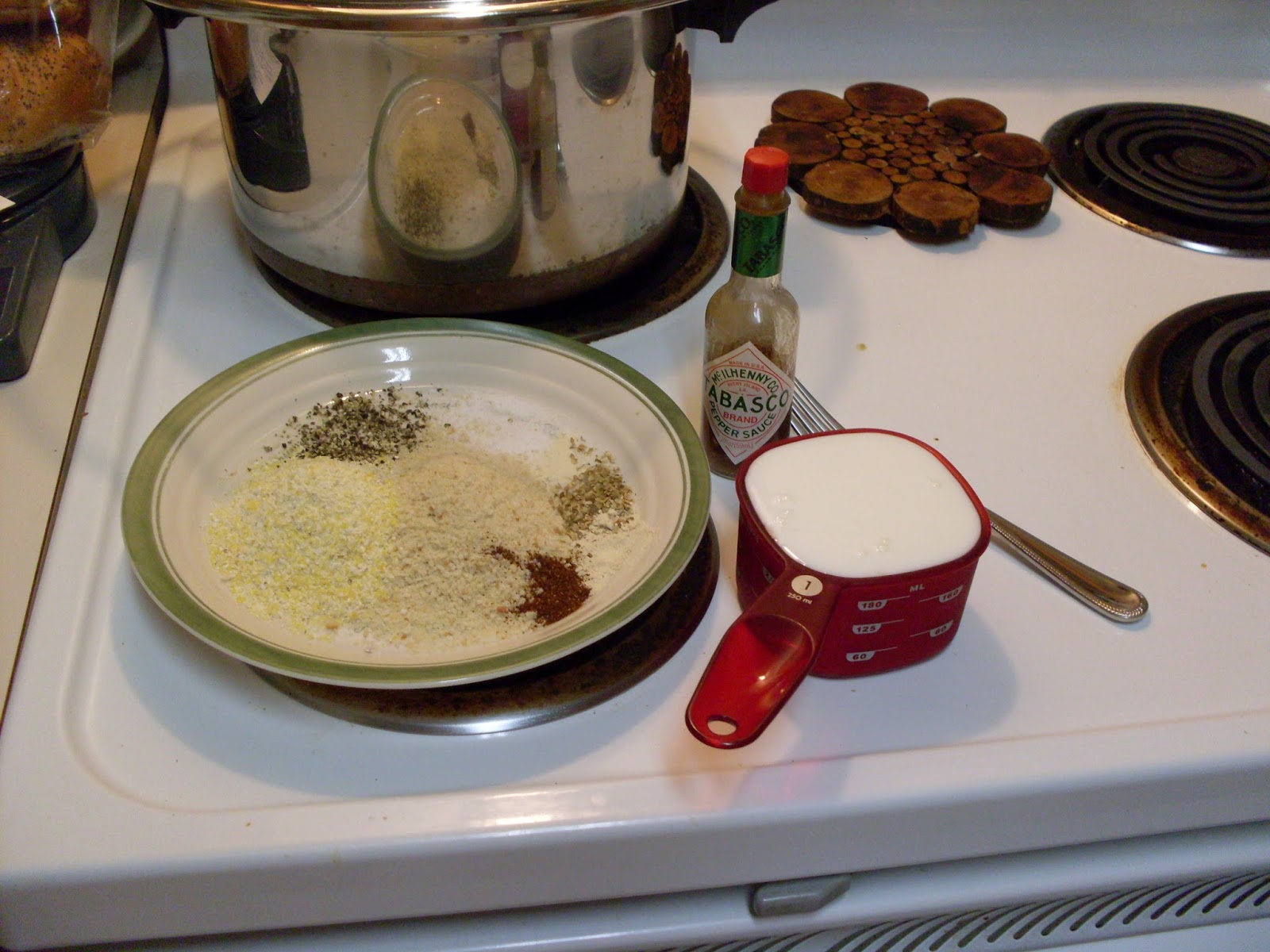
1 cup buttermilk(I made mine homemade by pouring 1 Tbsp. white vinegar into a 1 cup measure and filling the rest of the cup with milk. Let it sit about five minutes before using.)
Tabasco, to taste
Butter/Canola oil/Bacon grease(You can use any of these or a combination of them. I made a batch for my parents with butter and canola oil, but mine I made with bacon grease and canola oil.)


Slice the tomatoes crosswise into 1/2" slices. On a plate large enough for dredging the tomatoes, combine the flour, cornmeal, and dried seasonings. Mix well. Pour the buttermilk into a bowl large enough to hold the tomato slices; you can do this in rounds if you need to. Add the Tabasco to the buttermilk and mix well. Soak the tomato slices for a few minutes in the buttermilk before dredging in the cornmeal mixture. Set the coated slices onto another plate and let sit for five minutes or so to let the coating adhere firmly to the tomatoes.

Heat the oil of your choice in a large frying pan over medium heat. When hot, add the tomato slices. You will have to be very gentle with these when they fry because the tomatoes are delicate and the coating is even more delicate. It will fall off very easily if you are not careful. When they are deep brown, remove them from heat and gently dab at them with a paper towel to absorb the excess oil.

You can eat these plain or with a sauce of your choice, but I made mine into a BLT. Well, a BT, because I didn't use lettuce. I bought some lovely poppyseed kaiser rolls, sliced one in half, and toasted it in the oven. I fried up thick-cut bacon and used some of the leftover grease from it to fry the tomatoes while the bacon rested and the roll toasted. Mayonnaise on the roll, then tomato slices, then the bacon, and it was fantastic!! It was just out of this world! I also tried a couple of the tomato slices plain to know what the texture and flavor of it was just on its own. I can see why this has become such a popular dish because it was just ridiculously delicious.

Peach Hand Pies:
Peach pie is another dish synonymous with the South and I felt they paired well with tomatoes. Both are in the height of their season this time of year. It's the perfect summertime dessert. I have done peach pie for this blog before, but this was different because they were individual-sized. I had a recipe card for it and I based mine off of it. I made a few changes based on my tastes. The recipe was for 16 servings, but I only bought enough dough for half, so I only made half. Now I have too much peach filling leftover and I'm not sure what to use it for. I will write out the recipe based on eight servings so you don't accidentally buy too many ingredients.

1/2 Tbsp. butter
2 tsp. cornstarch
3 Tbsp. sugar(I substituted unsweetened applesauce and it worked just fine.) + 1/2 Tbsp sugar(I actually did use this.)
1 lb. ripe peaches, unpeeled, pitted, and cut into 3/4" pieces
Pinch salt
1/2 Tbsp. lemon juice
1 pkg.(15oz) refrigerated unbaked pie crusts (The kind you unroll yourself, not the ones in a pie tin)
1/2 Tbsp. milk

1.) In nonstick 12" skillet, melt butter over medium heat. In cup, mix cornstarch with 3 Tbsp. sugar. Stir peaches, sugar mixture, and salt into butter in skillet. (If you use applesauce like I did, don't mix that with the cornstarch first, just add all of the ingredients to the skillet and stir well to mix.) Cook 25 minutes or until peaches are very soft and mixture thickens and boils, stirring frequently. Boil 1 minute. Remove skillet from heat; stir in lemon juice. Cool completely. (Mixture can be made up to 1 day ahead and refrigerated until ready to use.)

2.) Preheat oven to 425 degrees. Let pie crusts stand as label directs.
3.) On work surface, unfold 1 dough round; cut into quarters. Spoon 2 Tablespoons of filling in strip down center of each quarter, leaving about 3/4" dough uncovered at each end. Fold dough over filling. With fork, press edges together to seal. Transfer pies to ungreased cookie sheet. Repeat with remaining dough and filling. (You will need two cookie sheets for them.)
4.) Brush tops of pies with milk; sprinkle with remaining sugar. With knife, cut 1" slit in top of each pie to allow steam to escape during baking.
5.) Place cookie sheets on two oven racks. Bake 18-20 minutes or until golden brown, rotating cookie sheets between upper and lower oven racks halfway through baking. Transfer pies to wire racks to cool.
Makes 8 pies

This was one of the best meals I've had in a while. Tomatoes and peaches really do go well together. Both are fruits, and sweet. They evoke images of the South and summertime. I highly recommend both of these. You will not be disappointed. I promise!

Sources:
City Info

City Map

City Pic

City History

Fried Green Tomatoes History

Tuesday, February 28, 2012

Cooking Light Tuesday


Tonight I made Sausage, Tomato, and Arugula Fettuccine and it was quite possibly the most amazing pasta dish I've ever made in my life. It was super simple, but the flavors were great! Cherry tomatoes break down really easily in a frying pan, good to know...And chicken Italian sausage is fantastic! I used that instead of the turkey Italian sausage it called for since I'm not a huge fan of ground turkey. The arugula didn't taste very peppery, and got a little bitter after a few bites so I picked around that but maybe later in the year I'll try it out again. I think the best part, was the pasta. I used a new brand of fresh pasta and I may never be able to go back to the dried kind again. It had the best texture I've ever had for pasta. I loved, loved, loved this dish and seeing as it's stove-top only I can make it again in the summer when the fresh ingredients will be at their peak and I can possibly buy locally, and as for the cherry tomatoes, I could even grow those myself!

Sunday, May 30, 2010

May Cooking Club Recipe

The cooking club recipe for the month was from the Food Network, and it was Ina Garten's "Scalloped Tomatoes". I was a bit nervous, because I don't normally eat cooked tomatoes except in tomato sauce. I wasn't sure I'd like it or not. I ended up altering a lot of the recipe, but it still turned out really really wonderfully. I was surprised at how much I loved it. The original calls for you to chop up the tomatoes and sort of fry them in oil for a bit, but I decided to grill them since the rest of the dinner I was making would be grilled as well. This added a lot of flavor and depth to them, and I really recommend it this way. I chopped them up after they'd cooked on the grill and had softened up a bit. I added the bread to the grill too but it didn't toast up as well as I'd hoped. I chopped it up and added some of it to the tomatoes and left some for the topping.
The recipe called for rosemary as seasoning and as I'm not a huge rosemary fan, I used oregano instead. Everything went into the pan and I topped it with the rest of the breadcrumbs and some rice cheese Parmesan before baking it off and cooking the rest of my dinner.
I served it on top of grilled polenta rounds, and it had a flavoring similar to spaghetti sauce, but with a different, more solid texture. It was really good. I would make this one again for sure.