Showing posts with label rye. Show all posts

Sunday, December 27, 2015

Dining-In: A Culinary Tour of America-Portsmouth, New Hampshire


The Location: Portsmouth, New Hampshire
2013 population: 21,440; 88.5% white, 3.9% Asian, 3.9% Hispanic. 2013 per capita income: $40,437

Prior to the European invasion, Portsmouth had been home to the Abenaki and other Algonquian language-speaking tribes. Martin Pring is the first recorded European to explore the area in 1603. By 1630, Europeans were colonizing the area. A British fort, Fort William and Mary, was built near the village of Portsmouth, giving it added protection. Portsmouth is located on a river harbor that opens to the ocean, and is thus a strategic location for trading. Other industries included lumber, ship building, and fishing. By 1645, enslaved Africans were being used as a labor source. Portsmouth profited greatly from their role in the Atlantic Slave Trade.

The city was first incorporated in 1653. In 1679, it was named the capital of the colony of New Hampshire and also became a place of refuge for Puritan exiles from Massachusetts. In 1774, Paul Revere rode to Portsmouth and warned people that the British were on their way. During the Revolutionary War, the slaves helped defend the city from the British. Once the war ended, in 1779, a group of 19 slaves submitted a petition to the state asking them to abolish slavery in exchange for the role they had played in the state and the nation's freedom. The petition was ignored, but New Hampshire did eventually unofficially abolish slavery in 1783 when they changed taxation codes and reworded the state constitution. It was not officially abolished in writing, however, until 1857, when the state passed legislation that stated that a person's decent may not be used to deny them citizenship to the state. Though it wasn't until New Hampshire ratified the 13th Amendment on July 1, 1865, that it was truly and officially ended.

Portsmouth was incorporated as a city in 1849. Though President Lincoln toured through the state of New Hampshire, and the state sent soldiers to fight, the state itself was too far north to have had any battles fought on its soil. Though Portsmouth lost many men to the war, the city itself remained unscathed.

Today, there are many museums and historical buildings dedicated to preserving the early American history of Portsmouth. The city itself now is considered a politically liberal city with many colleges and universities. The publishing company, Heinemann USA, is located in Portsmouth. Portsmouth is home to a plethora of well-known names throughout history. A few recent names include: Ilene Woods, the voice of Disney's Cinderella, Brooke Astor, philanthropist, Samantha Brown of the Travel Channel, and Tom Bergeron, tv host.

The Food: New England Clam Chowder and Brown Bread

I couldn't not do New England clam chowder at some point in time with this blog project. It is so quintessentially New England that it would be criminal of me to neglect it. I know there are several types of clam chowder, but I wanted the traditional New England kind, with a dairy or dairy-like base and no tomato products in it. And soup needs bread, right? One of the most famous kinds of New England breads, is Boston baked bread, the brown bread with raisins, baked/steamed in a cleaned out metal can. But this isn't Boston and so I couldn't do that one. But I found a similar bread and made that one instead. The bread recipe comes from my own recipe collection, at this point in time, the source is unknown. The clam chowder recipe came from online.

Raisin Rye Bread
1 pkg. active dry yeast
1/4 cup water, 105-115 degrees
3/4 cup milk
1/3 cup molasses
1/4 cup butter
1 Tbsp. salt
1 Tbsp. caraway seeds
1 1/2 cups rye flour
2 3/4-3 cups white flour(I only needed the 2 3/4 and probably could have used less. I had to add a bit of water to get it to mix properly because it was too dry.)
1 cup raisins

1.) In a large mixing bowl, dissolve the yeast in the warm water.
2.) In a saucepan, combine the milk, molasses, and butter.
3.) Heat to lukewarm, 110-115 degrees. Pour into yeast mixture.
4.) Stir in the salt and caraway seeds. Beat in the rye flour and white flour with the raisins.
5.) Form a soft dough. Knead on a lightly floured board.
6.) Let rise in a buttered bowl, covered, until double in bulk, about 1 1/2 hours.
7.) Shape into a round loaf. Let rise on a buttered baking sheet, covered, for 30 minutes or until almost doubled. Slash the top.
8.) Bake at 350 degrees for 40-45 minutes or until the bread sounds hollow when tapped on the bottom.
9.) Let cool on a rack.
Makes one loaf, 16-20 slices
The bread was kind of tough to knead. I had to add water to it to get the flour to incorporate fully and I feel like it never rose as much as it was supposed to. In spite of all that, the flavor was fantastic! I bet you never thought that a caraway flavor would taste good with raisins, but it does! This is a nice, rustic bread that is good with lots of butter on it. I am going to try toasting a slice today and I bet it will be really great that way! This was super easy to make.

New England Clam Chowder-Dairy and Gluten Free
I have made the base for clam chowder in the past, when I worked in the restaurants I used to work at, but have never actually made it from start to finish before. I think it's a soup that people are intimidated by for some reason, but there is no reason to be. I wanted a recipe that was dairy-friendly and this one is! It's also gluten-friendly for those who need that. The original recipe that I will put in my sources section, has instructions for using canned and fresh clams. Because I used all canned, I will only write out the recipe the way I did it.

3 (6.5 oz.) cans chopped clams with liquid (Strain these with a strainer into a bowl. Keep the clams separated from the juice because you will add them at different points in the cooking process.)
1 (8oz.) can clam juice
3 strips bacon, chopped (I recommend freezing the bacon before chopping, it will make it so much easier.)
Olive oil, if needed (I ended up needing it, my bacon did not give off much fat.)
1 small onion, chopped
2 leeks (I used one large and it was enough.)
1 cup finely chopped celery, with leaves
2 Tbsp. sweet rice flour (Can use regular flour if gluten is not an issue for you. I had the rice flour on hand so I used it.)
1/2 cup white wine (I didn't have any on hand, but you'll note that sherry is listed as an optional ingredient in this recipe, at the end. I used it in place of the white wine at the earlier step instead.)
1/2 tsp. dried marjoram or thyme (I had marjoram on hand so I used it.)
1 bay leaf
Pepper
1-1 1/2 cups almond milk or alternate to dairy milk of choice (I used coconut milk and it was wonderful in this. Not the kind from the can, the kind from the cardboard carton like you would use for cereal. You'll find it at the store in the same place as the almond milk. Probably the same brand too.)
1/4 cup sherry, optional

1.) Cut off and discard root ends and green tops of leeks. Slice leeks in half lengthwise, remove outermost layer and discard. Run leeks under water, separating layers to rinse out sand. Slice leeks thinly.
2.) Cook bacon in a large pot, until crisp. Remove bacon from pot and leave about 2 Tbsp. bacon fat in the pan or use olive oil to make up the difference, if there isn't enough.
3.) Add chopped leek, onion, and celery to the pot and saute over medium heat until tender, about 5 minutes.
4.) Add flour and wine and stir about 30 seconds. Working slowly at first to avoid lumps, stir in the clam juice and deglaze the pan. 

5.) Add potatoes, marjoram, bay leaf, and pepper. Liquid should cover the potatoes. If it doesn't, add water to cover, and bring to a boil.
6.) Reduce heat to simmer and cover, for 15 minutes, until the potatoes are tender. Remove the bayleaf and discard.
7.) Using an immersion blender, puree about 1/3 of the potato mixture. Mix in the almond milk, reserved bacon, and the clams, and heat back to a simmer. Add sherry, if desired.
This was fabulous! I am looking forward to reheating this tonight because you know how soup always tastes better the next day. I ate this with the bread and some potato chips and it was a perfect meal for a chilly winter night. The clams and clam juice weren't smelly, which is nice. If I had had Saltine crackers or some oyster crackers, that would have been a lovely addition to the soup.

Clam chowder is easy to find in canned form at the grocery store, or in restaurants, but it really is not hard to make from scratch. If you have always wondered what it's like to make, you really should try it out. It did not take long at all, I had much better control over what went into it, and it tasted delicious! If you want to try out a dish that screams "New England," this is it!

Sources:
New England Clam Chowder Recipe

City Info

City Pic

City Map

City Stats

City History

Slavery in New Hampshire


Sunday, September 20, 2015

Dining-In: A Culinary Tour of America-Miles City, Montana

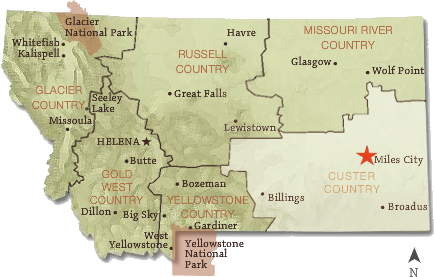
The Location: Miles City, Montana

2013 population: 8,646; 92.4% white, 2.7% Hispanic.
This region of Montana was populated with United States forts after the Battle of the Little Bighorn in 1876. A couple miles west of the Tongue River, Fort Keogh was built. It was named after one of the men who had died in the battle. It was commanded by General Nelson A. Miles, who is known for having driven the remaining Native American tribes, the Nez Perce and the Lakota, onto reservations in order to maintain control over them.
During this time, sutlers, or civilian merchants who sold their wares to military bases, provided the soldiers of Fork Keogh with copious amounts of whiskey. General Miles, in order to keep his men under control, threw the sutlers out in 1877. The sutlers moved two miles over to the east and founded Miles City. When Fort Keogh moved further west eventually, Miles City did too. This position is where Miles City currently resides today.
The 1880's brought cattle and horses to the open range around Miles City, and the railroad was nearby as well, both of which brought with it an increase in population. Miles City was where cattle were brought from Texas to be fattened up on their way to Chicago. Miles City grew into a thriving, typical "Wild West" town. It grew until the 1920's and 30's, when Billings, a town upriver to Miles City, grew and overshadowed them.
Cool Factoid: Though unconfirmed, according to the Guiness World Records, the largest snowflake, measuring 15" in diameter, was recorded on January 28, 1887 at Fort Keogh.

The Food: Rye Cracker-Bread and Montana-Stuffed Trout
Montana is known for their grain production, as well as their wild game. I don't eat game meat, for the most part, and don't have easy access to it, so I opted for another well-known Montana food: trout. Montana is also known for huckleberries and alfalfa honey. I tried very hard to find these, but had no luck. Actually, I did run across the honey at one store, but it was too expensive, so I didn't buy it. I have no idea why alfalfa honey is so expensive and so difficult to find in Seattle. I have heard it is quite delicious, though, so if you ever have the opportunity to try it, don't pass it up!
I wanted to try something a little different for the bread, and in my research, rye came up a lot in Montana recipes. I searched through my own recipe cards and ran across one that stood out to me. It was a little different than a typical loaf of bread, so I chose that. I think it was pretty easy to make and tasted fantastic! I will write out the recipe as it is written, but note that I made a half batch. A full batch would work if you're making it for a large group of people. A half batch still makes quite a lot and I have leftovers to take to work tomorrow. The recipe card is so old that I no longer know the source, unfortunately.

Rye Cracker-Bread
1/4 cup warm water
2 pkg. active dry yeast
1 tsp. each salt and sugar
1 cup milk
1 1/2 tsp. crushed caraway seed(I tried crushing this with a plate and a metal measuring cup and both failed. If you have a mortar and pestle, I would recommend that. If you don't, you can use a food processor or do what I did: use a coffee grinder I keep specifically for grinding spices.)
1 3/4 cup medium rye flour, divided(My store only sold dark rye, so that's what I used and it turned out just fine.)
About 1 1/4 cups flour, divided

In medium bowl, combine water, yeast, salt, and sugar. Let stand about 3 minutes to soften yeast. Add milk, caraway seed, 1 1/2 cups rye flour and 1 cup flour. Beat with quick on-off turns until well blended and smooth.(This instruction is for a mixer, but I just mixed it with a fork and it worked fine that way.)
Turn out on floured surface, and using remaining 1/4 cup flour, knead until smooth and elastic. Cut dough into 8 equal pieces. Shape each into a round bun; place on lightly greased cookie sheet, turn to grease top. Cover, let rise in warm, draft-free place 30 minutes or until almost doubled.
Punch down. Remove to lightly floured pastry cloth, and using remaining 1/4 cup rye flour and stockingette-covered rolling pin(I just used my normal rolling pin and it was fine), roll out each piece to a 9" round. Place on ungreased cookie sheets; prick entire surface with fork.
Bake 2 sheets at a time in a preheated 400 degree oven 4 minutes. Flip breads over, reverse position of sheets, and bake 4 minutes longer or until light brown and crisp. Remove to racks to cool. Store airtight in dry place up to 2 months. Serve broken pieces plain or with butter, cheese, dips, and spreads.
Makes 8

Some parts of this cracker bread were chewier and some were crunchier. It was really tasty and I loved the texture of both the crunchy and chewy parts. I did not put anything on it, I just ate it as-is, but I can see how it would be delicious with cheese or a spread of some kind. The rye flavor is really strong because of crushing the caraway first. It would overpower more delicate flavors, and any toppings you would put on would need to blend well with that strong, distinct caraway taste. Keep that in mind. It might sound complicated to make, but it was actually quite simple. This is a great way to ease yourself into bread-baking if you are not terribly familiar with it or confident.

My entree recipe was found online and I will provide the link in the sources, but I will go ahead and write out the recipe here. It is not my own, however.

Montana-Stuffed Trout
1/4 cup butter
1/2 cup finely chopped onion
1/2 cup finely chopped celery
1/4 cup chopped parsley
1 clove garlic, minced
1/2 tsp. salt
1/4 tsp. dried oregano
3 cups Italian bread, cubed
1 egg, slightly beaten
1 Tbsp. white wine
4(8oz) whole trout, dressed
1/2 tsp. salt
1 Tbsp. lemon juice
1 Tbsp. soy sauce
1/2 cup flour
2 slices bacon, cut in half

Melt butter in a large skillet over medium heat; add onion and celery, and cook, stirring constantly, until tender. Remove from heat. Stir in parsley and next three ingredients. Add bread cubes; toss gently. Combine egg and white wine; stir into bread mixture. Spread evenly into an 11"x7"x1 1/2" baking dish; set aside.
Rinse trout; pat dry. Sprinkle inside of fish evenly with 1/2 tsp. salt. Combine lemon juice and soy sauce; brush inside of fish, reserving remaining lemon juice mixture.
Dredge fish in flour. Place over stuffing, overlapping slightly. Drizzle with reserved lemon juice mixture. Place bacon over trout.
Cover and bake at 350 degrees for 45 minutes. Uncover and bake an additional 15 minutes. Garnish with a lemon slice, and/or a fresh parsley sprig.
The stuffing makes your house smell like Thanksgiving! The flavor pairs well with the trout. Bacon, soy, lemon juice, all blend well with trout. Trout is a very clean-tasting fish. There was no hint of fishiness. I took the skin off before eating and though it was a bit of a chore to pick out the bones, it was worth it. The texture of the fish was perfectly moist. Even though it is called stuffed fish, you can clearly see it isn't. The stuffing is more like a dressing, in terms of how it is cooked. So, maybe a more accurate name for this dish is Montana Dressed Trout...Either way, it was tasty! And just in case you were wondering, yes, I ate the whole fish! My time management was a bit off yesterday and I didn't sit down to eat till about 8:30pm, so I was pretty hungry by then!

Both of these recipes were fun to make. They felt rustic, but classy at the same time. Both turned out to be very delicious. I need to experiment with rye flour more often, and I'll be able to, because I had to buy a whole bag for this recipe!! Every time I bake with it now, I'll think of Montana!

Sources:
Trout Recipe Source

City Stats

City Map

City Pic

City Info

City History