Showing posts with label ground chicken. Show all posts

Sunday, March 6, 2016

Dining-In: A Culinary Tour of the World-Syria

 
The Location: Syria
Continent/Region: Asia/West
Capital: Damascus
Current Head of State: Bashar al Assad
Form of Government: Republic under an authoritarian regime
Official Language: Arabic
Main Religion: Sunni Islam
Ethnic Groups: Kurds, Syrian Arabs, Arameans
Formation Date: March 8, 1920, though it truly dates back to the 21st century BC. It is mentioned in the Bible.
Population: As of July 2014-17,064,854 people.
Currency: Syrian pound
Independence Day: April 17, 1946
Famous Americans of Syrian Descent: Shannon Elizabeth, Teri Hatcher, Queen Noor.
National Anthem:

The Food: Kibbeh and Monoushi Bread
Syria is part of Asia, but as part of the Middle East, its cuisine is closer to that of the Mediterranean, than what we might think of as typically "Asian". Being a largely Muslim nation, pork is not eaten. Beef and lamb are the major meats of choice. Olive oil, mint, bulgur wheat, and chickpeas are also eaten a lot in Syrian cuisine.

Monoushi, or Monoush Bread, is basically pizza dough. I ate it just plain, but it would be fantastic as pizza dough, or dipped in marinara sauce. It was really delicious and had a lovely, soft, chewy texture. The recipe made a dozen servings but was easily divided in half. I will provide the half batch recipe, but the link will be for the original serving size.

Manoushi Bread:

6 oz. flour (I actually measured this out on a scale.) 
1/2 tsp. yeast  
1/4 tsp. salt 
1/4 + 1/8 tsp. sugar  
87-100 ml warm water (3-3.5 fl oz) 
1/2 Tbsp. olive oil

Sift the flour(I actually didn't do this and it turned out fine) into a large mixing bowl and add the yeast and salt. (Or place it in the bowl of an electric mixer with a dough hook. This is what I did and I let the machine do all the work for me!)
Dissolve the sugar in the warm water and dribble it into the dry ingredients until they absorb enough to make a sticky dough. You may need more water than this. Have more ready, just in case.
Mix in the olive oil and use your hands – or the dough hook on your electric mixer – to knead the dough until it is smooth and silky. It will take about 10 minutes. (I found that after I added the oil, the dough didn't absorb it at first. I turned off the mixer, removed the dough and sort of stretched it out a bit by hand before putting it back in the machine. After that, it started mixing much better.)
Lightly oil the ball of dough and put it into a bowl. (I just kept it in the mixer bowl rather than dirty a second bowl.)
Cover and leave in a warm place to rise for 2 hours, by which time it should have at least doubled in size. 
Knead the dough, then tip it out onto a floured work surface. Cut the dough into 6 portions, then lightly flour each one and put them on a tray, covered, for another 10 minutes. 
When ready to bake, roll each portion out to a 6 inch circle and cover with the topping of your choice. (That is if you are using it like a pizza dough. Leave plain if you want it just for bread.)
Bake on a sheet pan in a 400 degree oven for 10 minutes or until baked through.

Kibbeh:
Kibbeh is Arabic for "ball", and it makes sense because these are or can be ball-shaped. The recipe says that this was easy, but I found them actually quite difficult to prepare. They were delicious and well worth it, though, but definitely took some work and time to make. They were also really unique as far as how to make the dough. I have never heard of anything like it, nor have I tried anything like it before. I was really excited to try it out and it turned out really well. Again, I made a half batch from the original, but will include the link to the original recipe as well.
1 lb. finely ground beef or lamb, lean, divided(I used ground chicken since I don't eat beef or lamb.) 
1/4 lb. bulgur cracked wheat, medium or #2
1/2 tsp. salt, plus 1/4tsp.
1/2 tsp. pepper, plus 1/4 tsp.
1/2 tsp. allspice
1/8 tsp. cumin
1 medium onion, 1/2 finely chopped, and 1/2 coarsely chopped, divided (I used less, probably half an onion, but use whatever amount you like most. It was pretty oniony, so I don't think it needed more.)
1/4 cup toasted pine nuts (optional) (I had these on hand and they really added to the flavor and texture. If you like pine nuts and have them available, I highly recommend adding them.)
1 Tbsp. olive oil
Vegetable oil for frying

In a medium bowl, soak wheat for 30 minutes in cold (I used hot water) water. Remove and drain. Remove excess water by squeezing through thick paper towel or cheesecloth. Place into medium bowl and combine with 1/2 lb. meat, coarsely chopped onion, 1/2 tsp. salt and 1/2 tsp. pepper. (I placed all of this in the food processor at the start.)

Combine well and place small amount in food processor until doughlike consistency. You can slowly add an ice cube at a time during processing if needed. (I did it all at once, as you can see, and it took a while for it to come together. I had to add some water to help it along. The ground chicken was still partially frozen which didn't help, but also took the place of the ice cubes.)
Place mixture aside, covered. Instead of using a food processor, you can use a mortar and pestle, however it will take you over an hour to achieve desired consistency.

In a medium frying pan, saute the finely chopped onion in olive oil. Add pine nuts if desired. Add ground meat and make sure to cook thoroughly and use a spatula to break it down into small pieces. Add allspice, salt, pepper, and cumin. Once meat is cooked, remove from heat. Allow to cool for 10 minutes.

Take an egg sized amount of shell mixture and form into a ball. With your finger, poke a hole in the ball, making a space for filling. Add filling and pinch the top to seal the ball. You can then shape it into a point, or football shape, or leave as a ball. (This is the hardest step. If you really just poke a hole, you can fit hardly any filling inside it. I ended up flattening the dough out on my hand, placing the filling in the center, and doing my best to fold it over the filling. The dough is pretty wet, though, and not that conducive to being folded. Just do your best. It'll turn out ok in the end.)

Fry in 350 degree oil on stove top or in deep fryer for about 10 minutes or until golden brown. I used tongs to turn each of them on their sides as well to make sure the sides get to cook too. Remember, there is meat in the dough, so it all needs to cook. Drain on paper towels. Makes 12 medium sized kibbeh.
In spite of the difficulty in forming the kibbeh, they were amazing! I was highly impressed. The outside was crispy and crunchy and the filling was flavorful. The filling made more than I could fit in the kibbeh, so I have some leftover filling to use up. I also have some leftover gyoza wrappers from my Bratsticker experiment a couple weeks ago. I sense this is something that will become my next potsticker filling. Maybe my dinner tomorrow night...!

As for alternatives, I can see how chickpeas would be a natural choice for making a vegetarian version of kibbeh. They would grind up perfectly with the dough and be great chopped up in the filling. The only thing I can think of for making this gluten free, though, is using quinoa instead of the bulgur wheat. I cannot vouch for the texture or how it would hold up, so if you try it out, and if it doesn't work, don't blame me!

You may be asking, why Syria? It's such a troubled nation right now, and highly controversial. Well, that's exactly why I chose it. Not to get too heavy and political, but I feel our country has not done a good job of helping out the people of Syria. I also think that food is a unifier and a wonderful way to get to know people. What better way to break down barriers and get over fears, than to share the food of the world with one another? If I can open one heart or mind with this project, than it was completely worth it.

This was a great start to my new cooking project. I love Middle Eastern food, so I knew I would enjoy it. I just had no idea I would enjoy it quite as much as I did. It's the sort of meal that makes you fall in love with a cuisine all over again!

Sources: (Note, just as before, I will not provide a link to the Wikipedia pages, since they are so easy to find, but assume that if no added links to stats or information is given, it came from Wikipedia)
Manoushi Bread Recipe

Kibbeh Recipe

Country Map

Country Flag

National Anthem

Stats and Information

Sunday, August 16, 2015

Dining-In: A Culinary Tour of America-Fort Collins, Colorado

 
The Location: Fort Collins, Colorado


2013 census: 153,061 people. 82.9% white, 10.3% Hispanic. Per capita income $29,987

Prior to the European invasion, the region was home to multiple tribes of Native Americans. The Cheyanne, Arapaho, Ute, Kiowa, Comanche, and Apache all lived there. Forts like Fort Collins were built to protect white settlers and their interests, and maintain control over the Native American population. By 1878, reservations for each tribe had been established and they were forced to move there. All but the Ute were moved out of the state of Colorado, to other nearby states.

Fort Collins was built in 1862. It was only used by the United States Army for a few years when settlers arrived in the area. The fort was decommissioned in 1867. The city surrounding the fort was built up in the 1870's and 1880's. The sugar beet and lamb industries were the top industries that helped build up the city's economy. It remained an economically strong city even through the Great Depression. World War Two brought with it a population boom and much of the city's original structures were replaced with newer models.

Politically, the city was known to be rather conservative. Alcohol was banned from the late 1890's until 1969 when students at Colorado State University protested against it. Today, the city is known for its robust beer culture.

Fort Collins is the fourth largest city in Colorado. It is also said to be one of the cities that was the visual inspiration for Disneyland's Main Street, USA, when Walt Disney was designing the park.

The Food: Chili and Cornbread

Colorado is a unique state in our country. It is part of the West, but it is also part of the Midwest, and it is part of the Southwest as well. Its cuisine is influenced by all of these cultures. It's known for its beef and lamb production, neither of which I eat. This presented some problems for me when trying to pick a meal for this state. I didn't want to just go with the Denver Omelet, because I felt that was too easy. I originally did plan on it, if I couldn't find anything else to use. In the end, though, I settled on chili and cornbread. I had a recipe card for chicken chili in the slow cooker and it even called for beer, so that fit in perfectly with the city's beer culture, though truth be told, that was a coincidence because I picked out the recipe before researching the city's history. It was a lucky choice, I guess!

I altered the recipe a little, as I always seem to do, so I will write it out how I did it, because I think it worked really well.

Slow Cooker Chicken Chili
1lb. ground chicken
3 Tbsp. + 2 tsp. chili powder
1(15oz.) can kidney beans, drained and rinsed
1(15oz.) can white beans, drained and rinsed
2(14.5oz) can fire-roasted tomatoes
1 med. sweet potato, peeled and shredded(about 10 oz.)
2 zucchinis, shredded
1(15oz.) can chicken broth
1/4 cup instant tapioca
1-2 chipotle chiles in adobo sauce with seeds, chopped
2 Tbsp. reduced sodium soy sauce
1 Tbsp. salt
1 Tbsp. onion powder
2 tsp. granulated garlic(I didn't have this and used powdered garlic and it was fine.)
1 tsp. dried oregano
1 tsp. ground cumin
1/4 tsp. cinnamon
Pinch ground cloves
1/2-3/4 cup lager-style beer, optional

Put the chicken in the slow cooker. Add 3 Tbsp. of the chili powder and the rest of the ingredients except the beer. Stir everything together, cover, and cook on low for 6-8 hours.

Just before serving, stir in the remaining 2 tsp. of the chili powder, the beer if using, and season with more salt and pepper to taste. Divide the chili among warm bowls.
Toppings: Sour cream, shredded cheddar or Monterey Jack cheese, chopped green onions.

Makes 6-8 servings.

This chili was amazing! I did the 8 hours and stirred it a few times throughout the day just to make sure everything blended together. When I added the beer and last of the chili powder I left the lid off and turned it onto high for a while to help burn off some of the alcohol because it was a little bitter otherwise. I used 2 chipotle peppers, but if spice is an issue, you might only use one. I wouldn't recommend skipping it entirely since that's the only spice source in the recipe. Chili powder isn't spicy, so there's nothing else in it to give it the spice you want in chili.

The recipe originally called for two pounds of ground chicken, but I felt that was too much and substituted half of it with the zucchini. I think it worked out just fine. The flavor blends overnight in the fridge and is even better the next day. Chili freezes really well, so I will be putting one-cup portions into zip-lock bags to freeze for later meals. It's a good way to make a batch of chili go a long way!


 The cornbread recipe I found online and it hails from an inn in Colorado. Cornbread is pretty generic as a dish so I wanted to find one relevant to the state. This also marked the use of a new ingredient for me. I have never used creamed corn before. It has a really deep corn flavor but a sort of strange texture for my tastes. It's probably fine cooked into things but I don't know that I would really ever eat it plain. And this means I need to find something else to cook it in this week because I have about a third of the can left and I don't want it to go to waste. I spent good money on it.

Since the recipe is online I won't write it out here, but I will talk about the one change I made to the recipe. I made a half batch since it was easily divided in half. Instead of a half cup of sugar, I used a half cup of unsweetened applesauce, my main go-to for replacing sugar. Since I don't know what it would be like if I'd used sugar, I guess I can't say for sure if it worked just the same. I think it turned out fine, though. It's a different type of cornbread because it's more wet from the applesauce and creamed corn, but it was supposed to be that way. My first piece crumbled when I took it out of the pan, but the second piece held up better. It just needed to sit for a while before being cut. I found it sweet but not overly sweet and really delicious with some butter on it.


This would be an ideal autumn meal, but it's good any time of the year because the crockpot keeps from heating up the kitchen. I was really happy with the results of this meal. It was easy to make and very tasty. I highly recommend it!

Sources:
City History

Native American History

Cornbread Recipe

City Stats

City Map

City Pic

Sunday, March 22, 2015

Dining-In: A Culinary Tour of America-Cincinnati, Ohio

The City: Cincinnati, Ohio
This is the first big city I've explored so far on this journey and I am really happy I chose it. When I thought of this project, this was one of the first destinations I came up with and I knew exactly what I wanted to try here. I was not disappointed.

Cincinnati is Ohio's third largest city and was founded in 1788. It has approximately 332,252 people living there and as of the 2007 census, 23.5% of them live below the poverty line. It is the 10th poorest city in the nation.


The city's geographical location made it an important place during the Civil War. The city is located along the Ohio River, which shares a border with the state of Kentucky. Kentucky was a slave state, and Ohio was a non-slave state, however, a lot of people in Ohio did business with slave-owning businesses in the bordering states, so the citizens of the city supported both sides of the war. The Union Army, however used Cincinnati as a major supply base.

Cincinnati is also the location of some rather interesting firsts for American history. The first major league baseball game was played there in 1935, and it also is home to the first concrete-reinforced skyscraper that was built in 1902.

The Food:
Cincinnati/Skyline Chili
Cincinnati is known as the "Chili Capital of America"-sorry Texas. I have seen Cincinnati's chili highlighted many times on the Food Network which is where I saw it first and decided I wanted to try making it sometime. When I had to pick a place in Ohio to feature, there was no doubt in my mind that it would be Cincinnati, and I knew the food would be the chili. If you have ever heard of the term "Cincinnati Threeway," this is what they're referring to. Each "way" refers to another addition to the toppings. The chili is a meat-based sauce without beans. One of the "ways" you can have it, is with beans added. I kept mine very traditional as far as toppings go, but I did revamp the chili itself to fit my own dietary needs. I based it on one recipe I found online and tweaked it based on some of the comments that explained how the original version was. I will provide the link to the original recipe, but I will write out what I did for mine for you to read here.

Cincinnati/Skyline Chili:

Ingredients:
1/2 large onion, chopped
1 pound ground chicken
1 clove garlic, minced
1 tablespoon chili powder
1 teaspoon ground allspice
1 teaspoon ground cinnamon
1/4 teaspoon red (cayenne) pepper-this can be doubled if you like more heat.
1 bay leaf
1/2 teaspoon salt
1 (15-ounce) can tomato sauce
1 tablespoon Worcestershire sauce
1 tablespoon cider vinegar
1/2 cup water
Toppings (see below)

In a frying pan, cook the onion, garlic, and chicken in a little bit of oil. I used canola, but vegetable or olive oil would work well too.

Mix the tomato sauce, water, and all the spices in a crock pot, and when the chicken and onion mixture is cooked, pour it into the crock pot as well. Cook on low for 3-4 hours. You can do this on the stove as well if you want, but the crock pot is the greener option for something that needs to simmer for a long time. It uses far less energy to use a crock pot than the stove top. If you do use a pot on the stove, simmer for 1.5 hours.

The toppings are traditionally as follows:
 
Two-Way Chili:   Chili served on spaghetti
Three-Way Chili:   Additionally topped with shredded Cheddar cheese
Four-Way Chili:   Additionally topped with chopped onions
Five-Way Chili:   Additionally topped with kidney beans

I did mine as the three-way. I cooked pasta, I used fettuccine because I had a box I wanted to use up, but I think any pasta would work. Elbow macaroni in particular would work really well. As with one of the comments in the link I used, it emphasized the importance of using oyster crackers over the pasta too, which I did as well. They got pretty soggy pretty quickly, but I think the next time I'll put them over the very top so they'll be crunchy for longer. I also used shredded cheddar cheese, which to me was a vital flavor component.


This was so good! I was concerned about the allspice and the cinnamon but it really was a great addition to the spice blend. I think it'll improve over time too, so I am really excited about the leftovers tomorrow night. I'm sorry that nobody else will get to taste-test this, but I will be keeping all the leftovers for myself! It was that good.

I would definitely make this again and I will probably double the recipe and freeze portions because I don't see why it wouldn't freeze and thaw out easily. This was a great alternative to spaghetti sauce and I cannot recommend it highly enough. It was super easy to make. Almost embarrassingly easy.

Sources:
Map

City Pic

Census Info

Cincinnati Chili recipe

All historical info came from Wikipedia

Sunday, February 15, 2015

Dining In-A Culinary Tour of America: Valentine, Nebraska

The City: Valentine, Nebraska, aka, "America's Heart City"
According to the 2010 census, the population of this town is 2,737. Of this total, 86.3% is white and 9.1% is Native American. As of the 2000 census, the per capita income was $22.715, and 6.4% live below the poverty line.

Valentine, just north of the Niobrara River, was founded in 1883 when the Sioux City and Pacific Railroad came through that part of the country. As we saw last week in Pocatello, Idaho, railroads were a big factor in when and where cities in this country were established.

The city was named after Congressman E.K. Valentine, who won an election just prior to the city's founding. During its first few years, the population tripled, which brought with it a huge increase in violent crime. Eventually, a "no guns in the saloons" policy was enforced, and helped to curb violent crime.

Fun Fact: Valentine participates in a mail rerouting program. During the time before Valentine's day, mail is rerouted through the city's post office, where it is given a special Valentine postmark as well as a Valentine's day message stamp.

The Dish: Runza
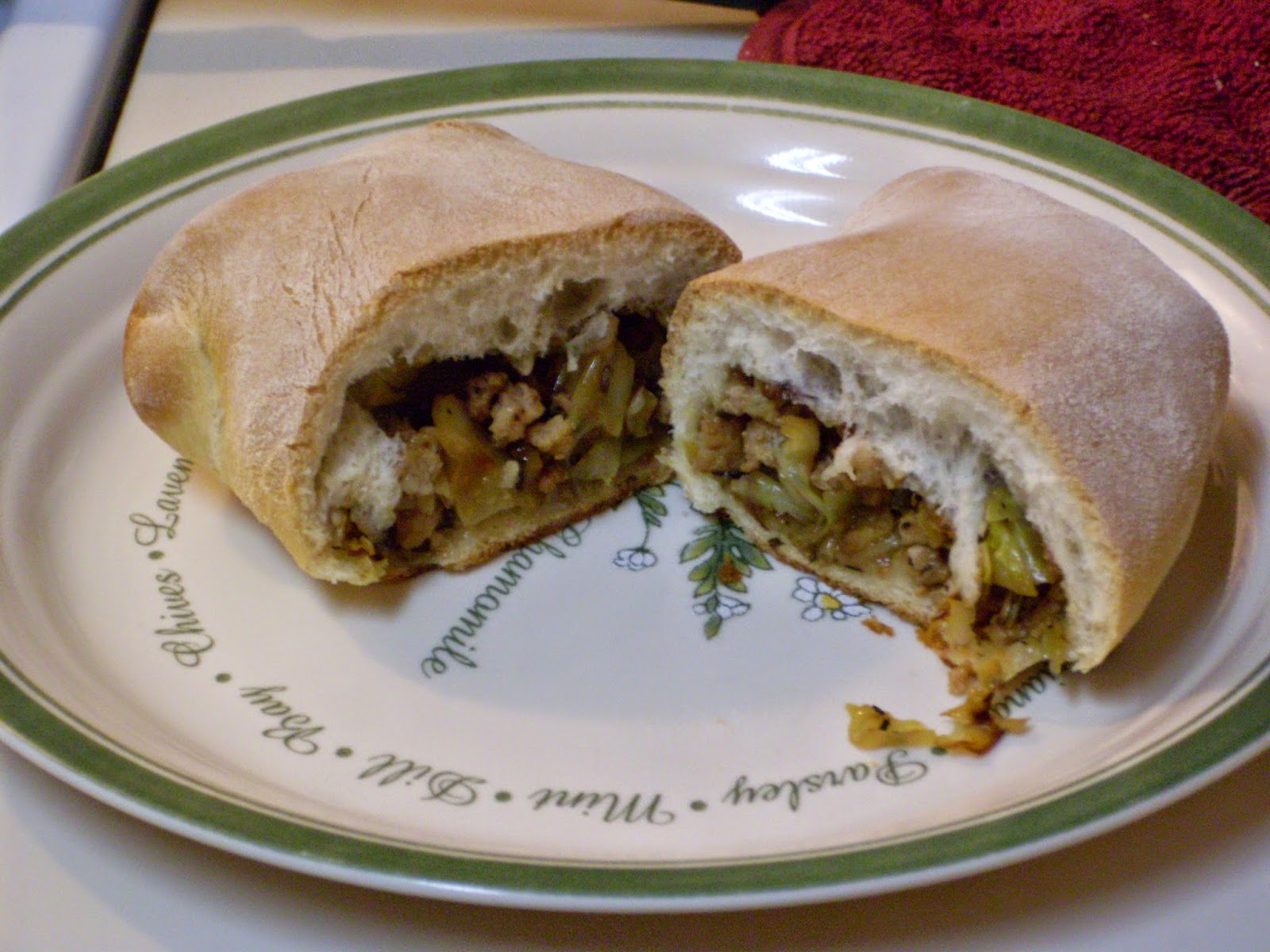
I had never heard of this food before I started looking around for cities that I could associate with Valentine's Day. When I ran across Valentine, Nebraska and started researching foods of Nebraska, this word popped up over and over again. Runzas are apparently so popular in Nebraska that there is even a chain of fast food restaurants name after it. When I looked it up I got really excited because of its history and knew I had to do it. Runza, also known as bierock, fleischkuche, or Kraut Pirok, is a meat and cabbage-filled bread dough that hails from the same German colony in Russia that my great grandfather and his family were from.

Almost every culture has a dish like this. Think of pierogies of Poland, humbow from China, or pasties from Britain. Samosas and empanadas are other examples. A dish that is small enough to be held in your hand, has a hearty filling, but with a casing that keeps it from making a total mess when you eat is important. You can make them ahead of time and take them to work or school and eat them on the go if need be. I was very happy to see that my own heritage has its own contribution to this delicious and practical culinary tradition.

And now a bit of a tangent in which I wax poetic about Volga Germans and my own background. Back in the mid 1700's, Catherine the Great, who was German but had married into the Russian royal family, took over as Queen(apparently there was a whole thing and a deposition of her husband and a conspiracy to assassinate him and all sorts of drama) and invited Germans into the country to settle the vast prairie-like lands along the Volga river. They were given complete autonomy and did not have to pay taxes or serve in the military. They spoke their own language, established their own churches, and kept to themselves. My great grandfather was born in Saratov, Russia, which was in the middle of this area. When he was a very young child, the attitude in Russia was changing towards the Volga Germans. They were told they had to start paying taxes, serving in the military, and basically to completely assimilate with the greater Russian population. Many of the people, my family included, didn't want to do this, so they left. Many of them settled in the Midwestern states of the US, but my family want to Canada and settled in Calgary, Alberta. These areas in both the US and Canada have a similar environment to the land they had known in Russia. Not everybody left, however, and the majority of those who stayed behind would end up being rounded up during the Second World War and shipped off to Siberia, seeing as Germany was an enemy state to Russia. A lot of people died there, but those who survived ended up staying and there is still a large population of ethnically German Russians in Siberia today.

Ok, now that I am finished with that, I can get back to the actual dish. I found a few good recipes online and used those to base mine off of. I had planned to make the bread dough myself but I had a time crunch at the last minute and when I compared prices to buying a bag of bread flour versus buying those bags of frozen dough(I used Rhodes brand) and seeing it was pretty much the same price, decided to get the already made dough instead. I would like to do this again sometime and make the dough myself.

The filling was really simple. I switched out ground chicken for the ground beef and kept the seasonings exactly as it called for in the recipe. I used only fresh cabbage in mine but I can see how using sauerkraut or a mixture of both could be amazing. If you like sauerkraut, that is. Which I do. You could even add diced cooked potato in this too if you wanted, but then you'd be dangerously encroaching into pasty territory.
 After being filled and resting a second time. Just before putting them into the oven. I wasn't sure how big they'd get so I put them on two sheets.
After coming out of the oven. I moved them all onto one sheet to rest for a few minutes before trying one.

I wasn't able to fit as much filling in them as I would have liked. The recipe said to divide the dough into 8 pieces and it's possible that if I'd made the dough myself it would have made enough to create bigger pieces, but it was still filling. The cabbage is slightly bitter which works well with the salty, savory flavors mixed with it. The dough was delish and held its own against the filling. There was no mess and it was really easy to eat. I am not going to write out the recipe since I largely used one I can link to, so I will post the link to it here.
These were amazing! I forgot to add the egg wash on the top like the recipe said to do. Obviously it looks different without it and it might have been a bit crunchier with it, but I didn't miss it, personally. I followed the bread package instructions for cooking temp and time and did 25 minutes. I think the full 30 would have been too much time.

The next time you have a hankering for German food but want to try something a little different, I would highly recommend this. It was pretty simple to make and really good. I was originally going to serve this with roasted potatoes with caraway seeds, but I just made soup instead. Two of these plus the soup was a perfect-sized meal.

Sources: Just a reminder that I am not posting anything from Wikipedia, just assume that I use that as the base of my research and it's easy enough to look it up there so I don't feel the need to post a link to it. I just post links to the other sources.

The Recipe

Runza History

Valentine City History

Map

City Picture


Saturday, March 8, 2014

Magical Swedish Meatloaf

Last night I was told that the Swedish meatloaf I made for our Friday night family gathering was "magical", and it got enough raves that I thought I'd share the recipe here for anybody who would like the recipe for themselves. It was originally a Swedish meatball recipe, and had different ingredients, but I modified it for my own personal tastes and developed it into a meatloaf recipe in order to cut out a lot of the prep time. If you are not familiar with making meatballs, they are a very labor intensive dish. So, the following was my solution to it.

Swedish Meatloaf:
1/2 onion, peeled and grated
2 Tbsp. butter
2/3 cup milk
5 slices of white bread, crusts removed, diced
2 eggs
1 lb. ground pork
1 1/2 lb. ground chicken
2 tsp. salt
1 tsp. nutmeg
1 tsp. ground cardamom
2 tsp. pepper

1.) Saute the onion in the butter over medium-high heat until the onions soften and turn translucent, 3-4 minutes. (You aren't looking to really brown them or caramelize them.) Remove from the heat and cool.
2.) In a large bowl, mix the bread pieces with the milk. Set aside for a few minutes to let the milk absorb into the bread. When it's absorbed, use a fork to mask into a smooth paste, or use your fingers.
3.) Add the cooled onions to the paste and mix very well. Add the eggs and spices and mix very well into the paste. When it's been well-incorporated, add the ground pork and chicken and mix very well. (This will take a few minutes to really make sure the two different meats have blended as well as mixed in with the bread mixture. This takes patience. It will be a very runny mixture when it is complete, don't worry, it'll firm up when it cooks.)
4.) Pour into a standard-sized loaf pan, you don't need to grease it, and bake in a 350 oven for about an hour to an hour and fifteen minutes. Halfway through the baking, check to see if there are a lot of juices accumulating and pour them off if you need to. You will need to do this again at the end as well. Ground chicken has a lot more moisture in it than other ground meats and you don't want to steam/boil this.(Do not discard the drippings, save them for the gravy)
5.) When the meatloaf is at least 165 degrees internally, remove it from the oven and allow it to rest for ten minutes or so before cutting into it. I usually serve this with plain noodles and the gravy that I will share the recipe for as well.

Gravy:
6 Tbsp. butter
1/3 cup flour
1qt. chicken stock
1/2-3/4 cup sour cream
salt, to taste

1.) Melt butter in a 2 qt. saucepan. Whisk in flour. Let the mixture cook until it is a rich brown color, stirring constantly.
2.)As the flour mixture(roux) cooks, heat the chicken stock in another pan until it's simmering. Slowly add the chicken stock a little at a time. Stir well until the sauce is smooth and thickened.
3.)Remove the sauce from the heat and add the sour cream and salt to taste. Mix until fully incorporated and serve on the meatloaf and noodles.

Now, if you're like me, you don't always have time to make homemade sauce like this, or you don't always have the chicken stock on hand. I developed an alternative to this that I think works very nicely. Take a packet of chicken gravy mix(foodies might cringe at this, but we all know we use this stuff, don't try and pretend you're too good for it), and prepare it as the instructions call for. When it is made, strain the drippings from the meatloaf into the gravy and return to a boil. Allow it to boil for a few minutes to make sure the drippings come up to the proper temperature. When this is done, remove from the heat and add as much sour cream as you want. And, voila! There you have, easy semi-homemade gravy for the meatloaf that took a lot less time and butter...

This meatloaf makes about 6-8 servings depending on how large a serving you want. I also discovered that it freezes and thaws very well. You can make a whole recipe, eat it for a day or two and then wrap and freeze portions for another time. The gravy, however, you would need to make fresh each subsequent time. So there you have it, my Swedish Meatloaf recipe. Enjoy!