Showing posts with label fish. Show all posts

Monday, January 18, 2016

Dining-In: A Culinary Tour of America-Conway, Arkansas

 
The Location: Conway, Arkansas
2013 population: 63,816; 75.3% white, 15.6% African American. 2013 per capita income: $24,465.

Conway was established as a railway town after the Civil War ended, by Asa P. Robinson. In 1878, a priest named Father Joseph Straub, who had founded the Duquesne University in Pittsburgh, Pennsylvania, moved to Conway. He built the St. Joseph Colony there. Both the railroad and Father Straub worked diligently to attract German and Catholic German families to the area. By 1889, more than 100 German families called Conway home.

Conway's proximity to the Arkansas River makes it a popular fishing destination.

Claim to fame: Conway is said to be the city that singer Conway Twitty took his name from.

The Food: Catfish, Collard Greens, and Cornmeal-fried Veggies
So, when I was thinking about what to do for the state of Arkansas, catfish immediately came to mind. I knew it was risky, though, because this is Seattle, and catfish is not native to this region. Nor is it particularly in high demand, which means the chance of me finding fresh catfish when I needed to, was very low. But I was determined to make it work. I lucked out, though. Last week my grocery store had one portion of catfish in the fresh fish section on discount. Not sure why it was discounted, because it was well within its use-by date. Probably because of demand, I would assume. Well, I snatch it right up and looked very carefully at the label. It did not say it had been previously frozen, so I made a risky decision and froze it. I normally would never do this to fish, but you can't keep fish in your fridge for a week before you use it, so it was either freeze it or not use it all.

I wanted a simple catfish recipe because I've never had it before and I wanted it to shine as a flavor and didn't want whatever I put on it to outshine or mask it. I found a very delicious and simple recipe that was also very easy to make. I was happy because it was steeped in Southern ingredients and just screamed "The South". Here is the recipe:

Pecan Catfish
1/2 cup cornmeal
1 teaspoon salt
1/4 teaspoon ground black pepper
1 1/4 pounds catfish
3 tablespoons vegetable oil
1/2 cup pecans, finely crushed
5 wedges lemon, for garnish
5 sprigs fresh parsley, for garnish

Preheat oven to 500 degrees F.
In a large bowl, mix the cornmeal, salt and pepper. Dip the catfish in the cornmeal mixture; coating well.
Place catfish on a flat, greased baking sheet. Pour the oil over the fish.
Bake in the preheated oven for 15 minutes or until catfish flakes easily when tested with a fork. Sprinkle with pecans toward the end of the cooking period.
Garnish with lemon wedges and parsley sprigs.


The only thing I didn't do was the lemon wedges and parsley sprigs. I just squeezed lemon juice over it all when it came out of the oven. I did it exactly as it was called for, except I put mine on parchment paper on the sheetpan instead of greasing a sheetpan. That worked just fine. I put the pecans on probably for the last 4 minutes. They will burn in an oven that hot, so don't add them too soon.

This one was really good! The sweetness of the pecan and the tartness of the lemon complimented the fish, but didn't overpower it. And that turned out to be a good thing, because catfish is a really delicate fish. It's a white fish, that just tastes really like the ocean, which is odd because it's a fresh water fish, but it does! It's like fish, but not fishy, if that makes any sort of sense. I highly recommend this one if you can ever get your hands on catfish.

And for my vegetable side, I knew I had to go with collard greens. This again was a risk because it's Seattle in January. Well, it turns out that collard greens are a cold weather vegetable, so I actually timed it perfectly. And it also turns out that my Safeway sells organic collard greens, so it wasn't too much of a challenge at all!

Most people prepare collard greens with ham flavoring the liquid. I am one of those unusual people who doesn't actually like ham-flavored things. I like ham, I like beans, and greens, and pea soup, but not together. So, that meant a vegetarian version. Luckily I ran across a great recipe that seemed easy enough.

Vegetarian Collard Greens 
2 lbs collard greens 
4 -5 garlic cloves, minced 
1 large onion, chopped 
3 cups vegetable stock 
1 teaspoon salt ( to taste) 
1 teaspoon smoked sweet paprika 
1/2 cup apple cider vinegar 
hot sauce (optional) or red pepper flakes (optional)

Wash greens well, submerging in a sink full of cold water to remove any dirt and grit. Drain well. Cut off the stems right where the leaf starts. Stack about 5-8 leaves on top of eachother, then roll lengthwise. Cut rolled up leaves into 1" slices widthwise. Repeat until all the greens are done, and add to a large pot. 
Add all other ingredients. Cover and bring to a boil over high heat, then reduce heat to a simmer. Simmer for 45 minutes or until greens are extremely tender. Serve hot, using a slotted spoon to drain the liquid from the greens.
 
So, this started off just fine, and I had it on the back burner doing its thing while I worked on everything else. I thought that it would be fine, because the greens would release their liquid and it would basically stew until I was ready to serve it. That's not how it ended up, unfortunately. I did not take an "after" picture, because I burned the heck out of it and it was ruined! I did try a not-burned bit just to see if it was salvageable. It was very bitter. I'm not sure if that's because collard greens are bitter or because it sat and burned for a half hour, but either way, it was not edible. I was sad, because it was a solid recipe! But, lesson learned, collard greens don't actually give off that much liquid, so make sure to add lots to the pot and check it once in a while!
 
To round out the meal, I wanted a starch and an interesting way of preparing it. I found a recipe that seemed pretty simple and went with it. 
 
Arkansas Fried Veggies
1 cup milk  
1 egg
1 cup cornmeal, or as needed
2 squash, sliced
2 red potatoes, cubed
2 green tomatoes, cubed
3 pods fresh okra, sliced into rings, or more to taste
1/2 onion, diced
1/2 green bell pepper, diced
2 tablespoons bacon grease, or as needed
Salt/pepper to taste

Whisk milk and egg together in a large bowl. Pour cornmeal into another large bowl.
Dip squash, potatoes, tomatoes, okra, onion, and green bell pepper into milk mixture; press vegetables into cornmeal to coat.
Heat bacon grease in a large skillet over medium-high heat. Cook and stir vegetable mixture in hot grease until golden and tender, 15 to 25 minutes. Season with salt and black pepper.
 
I used this recipe as a base but didn't do all the vegetables listed. I used what I had on hand, which last night happened to be fingerling potatoes that I cut into quarters, green beans, and sliced frozen okra that I thawed out. I cooked the potatoes first because they need a lot more time than the other vegetables. As golden as they got on the outside, they were still not cooked through, so I threw them on a sheetpan and put them in the oven while the catfish baked. That seemed to be enough extra time to cook them through. I fried the other veggies while the potatoes baked. 

This recipe was ok, but not amazing. The problem is that when you fry cornmeal, it gets rock hard, so you're eating these crunchy nuggets with little bits of cornmeal getting stuck in your teeth. I bet it would be better if you ground up the cornmeal into smaller pieces. That might have worked better.
There was a lot of cornmeal in this meal, but cornmeal, catfish, pecans, collard greens, okra, and bacon fat is pretty much the epitome of Southern food, so it's fitting for this menu!

This meal might not have turned out perfectly, but it was a lot of fun to make. The catfish was delicious, and I do think the collard greens would have been really good if I hadn't burned them to smithereens...The veggies were ok, but the catfish was the star. Definitely try it out sometime if you can get your hands on some. It's worth it!

Sources:


Sunday, August 2, 2015

Dining-in: A Culinary Tour of America-New Bedford, Massachusetts


The Location: New Bedford, Massachusetts
2013 census: 95,078 people; 66.5% white; 22.2% Hispanic. Per capita income $20,517

New Bedford is nicknamed "The Whaling City," because it was a large whaling port in the 19th century. Fun fact: In 1841, Herman Melville shipped off on the Acushnet whaling ship from New Bedford. His experiences on that ship would inspire the story of Moby Dick.

Prior to the European invasion, the region was home to the Wampanoag tribe who numbered approximately 12,000. New Bedford was settled by Europeans in 1652. The city's first newspaper was founded in 1792, as was the first post office. When Europeans began to arrive, they came in several different waves of ethnic groups. First came the British Protestants, and then the Irish. With the advent of the first cotton mill in 1846, came the Portuguese. After them came the Polish and Eastern European Jews in the late 1800's.

New Bedford, along with Fall River and Greater Providence, have the largest Portuguese American population in the entire country. Every year, New Bedford is host to the Feast of the Blessed Sacrament, a festival devoted to Portuguese and Portuguese-American culture. This year marks the 101st year, and it runs from July 30-August 2nd. Events include a parade, fado singing(think Portuguese blues, a genre dominated by women), and tons of Portuguese food. The feast was started at the Church of the Immaculate Conception in 1915. It was an homage to a similar feast celebrated each year in Madeira Island.

 Here is a video of an example of fado singing. It's quite lovely, I think.


And here is a video of folk music and dancing at a past Feast of the Blessed Sacrament, so you can visualize what it's like there.


In honor of the Feast of the Blessed Sacrament, an event that I was first introduced to in the movie Passionada, a lovely romance starring Jason Isaacs wearing a horrible wig, I decided I had to partake in it when I began this food blog. I have never cooked Portuguese food before and it all looks so amazing, so I was very excited to try it. I chose two recipes and both of them included ingredients I'd never used before. It turns out that I will probably never use one of them again...

The Food: Caldo Verde and Bacalhau

 Salt Cod, out of the box

Bacalhau: Basically salt cod cakes or fritters. I used a recipe from The Frugal Gourmet on Our Immigrant Ancestors cookbook by Jeff Smith. The recipe did not turn out so I will not bother writing it out here. I'll just explain what happened.


Salt cod, after soaking for a day

I cooked with salt cod for the first and probably last time yesterday. Salt cod has a long history, it dates back at least 500 years. It was a way of preserving food for the long winter months and some say it makes the fish taste even better. That might be a bit of an exaggeration. It took an email, a trip to two different stores and $12 for me to track down the salt cod. It is not easy to find in Seattle. But find it I did. I followed the instructions to soak it in water starting late Thursday night. I kept it in a pan of water in the fridge and changed the water several times on Friday and Saturday morning. I think maybe I did it too soon because it didn't seem to have any flavor when I finally cooked it up. All the salt was gone. To cook the fish, you just simmer it in water for about a half hour. Do you know what the smell of boiled over fish water on your stove as it evaporates on the burner smells like? I hope you don't. Because I do, and I wish I didn't...

The breading was made by leaving fresh bread out to dry and grating it into breadcrumbs. I didn't have quite enough so I used panko for the rest. You mix this with olive oil, fresh garlic, and spices. When the fish is cool enough to handle, you crumble it into flakes and mix it into the breadcrumb mixture. I did not realize until it was too late that it was not boneless fish. I got some of the bigger bones out, but I'm pretty sure I was feasting on fish bones last night...Not a pleasant thought.


The breading didn't keep the cakes together. It needed more of a binder, maybe an egg or milk or something. When I formed the cakes, they just crumbled but I fried them up anyway. It turned into basically a breaded fish hot mess hash. The flavor was pretty good, though the fish was no longer flavorful. The garlic was a very good addition and worked really well with it. I put some lemon juice on it and that turned out pretty good too, but it wasn't enough to save this trainwreck of a dish. Because salt cod is so expensive, hard to track down, and labor intensive to prepare, I don't know that I will ever try this one again, but it was a fun experiment. I think if I ever want to try it again, I'll splurge and go to a restaurant that has them on the menu.

Caldo Verde: This sounds like a really exotic dish, but it's Portuguese for kale and potato soup with linquica sausage. Linguica sausage is another new ingredient to me that took a while to track down. It looks like kielbasa but it's redder and has a milder flavor. In case you want to try this sometime, Safeway carries it. It's a tad expensive, but it's there. If you can't find it, kielbasa would make an ideal substitute. I have heard this of this dish over the years but never attempted it before. This one was a winner, thankfully! I will post the link to the original recipe because I found it online.

Caldo Verde is what you would call "peasant" food. It has humble ingredients like potatoes, sausage, and kale. The sausage flavors the soup but isn't a main component. The potato and kale are definitely the stars of the show. Some versions also include beans, but I chose one that didn't since I don't always like beans in my food. It was very simple and pretty quick to prepare. It might not be the ideal food for an 85+ degree day, but it worked out just fine.

You start with four large russet potatoes, scrubbed, peeled, and sliced thin. Put them in a large pot and cover with two quarts of chicken stock. Cook for about 20 minutes until the potatoes are cooked through. In the meantime, chop two cloves of garlic and a small onion and saute in olive oil until softened. Put these into the pot with the potatoes. When the potatoes are cooked, remove the pot from the heat and puree with a hand-held blender or in a regular blender. If you have neither of these available, a potato masher would probably work though it might be chunkier than with the other methods.

At the same time as the potatoes are cooking saute 6 ounces of thinly-sliced linquica sausage in olive oil and when that has cooked until browned put in 1 lb. julienned kale(I used purple kale but use whatever you like the most. Just cut it off the stems and julienne in long strips.) to the frying pan. Cover and let cook down until partly cooked before pouring that and the sausage into the pot of pureed potato soup. Return the pot to medium heat and cook through until the kale has cooked down. Mix well before serving. You can put olive oil on the top if you like though I skipped that step.


The soup was really good and I think it'll be even better reheated. Soup always tastes better the next day, doesn't it? I gave some to my parents and grandparents to try and froze a couple servings so I'll get to enjoy it later on. The fish cakes tasted pretty good but visually they just didn't work. I think they're too impractical to try again, but I really did enjoy experimenting with it. I'll just wait until I get to go to the Feast of the Blessed Sacrament in person one day to try them made by people who actually know what they're doing. Do try the soup though, you won't regret it!

Sources:
Feast of the Blessed Sacrament website

Caldo Verde Recipe

City Map

City Pic

City Info

City Info


Saturday, February 7, 2015

Dining In-A Culinary Tour of America: Pocatello, Idaho

The City: Pocatello, Idaho

Why Pocatello, you might ask? Well, there's sort of a family connection to this name. I've never been there, but it's a name that my cousin, when she was very young, used to call my uncle, as a sort of nonsensical "insult". I think it was before I was born, but I think about that every time I hear the name.
Pocatello was named after a Shoshone chief, though in 1918, a linguist named Sven Liljeblad did research and determined that the name wasn't actually a real name, but a combination of several Shoshone root words. The chief's daughter confirmed that her father had never been called Pocatello, but went by the name Tonzaosha, which means "buffalo robe."
Pocatello was established as a stop for the first railroad in Idaho, during the gold rush of 1860. When the gold rush ended, farmers and ranchers came to the area and settled in.(Those who made it alive, that is, and didn't succumb to such tragedies as dysentery or wagons falling off rafts and drowning all on board. Or those who didn't get distracted with hunting buffalo...I am dedicating this tangent to my Oregon Trail days in computer class in elementary school. If you never played this game, then you missed out on some pretty awesome fun!)
The city is the home of Idaho State University and has a population of about 54,255, according to the 2010 census. According to the 2000 census, the city is about 90.5% white, and 7.2% Hispanic or Latino. 75.4% of the population is Mormon.
Pocatello fun fact: In 1948, after a particularly harsh winter, the city mayor passed an ordinance which made not smiling illegal. It was never repealed, and on December 10, 1987, the city was declared the "U.S. Smile Capital". There is even an annual "smile event" to celebrate this!

The Food:
Both of tonight's recipes come from my Idaho Cookbook, that I got on my whirlwind trip to Yellowstone National Park with my sister and my cousin back when I was a student at the University of Washington. I try to collect cookbooks from every state I visit, if I run across any. When I think of foods from Idaho, besides the very obvious potato, I think of trout. There are a lot of rivers in this state, so they catch a lot of trout there. I went with this as opposed to potatoes. I also found a roll recipe I tested as well. The trout recipe was shared by somebody actually from Pocatello, so it's even more authentic! I will be copying the recipes exactly as they are written and will put my own notes in parentheses. I do not own these recipes. I am providing a link at the end for you to order the book for yourself or see if you can get it through your local library if you are interested in exploring the book more.


Garden Grilled Trout:
3 Tbsp. butter
1/4 cup dry white wine
4 trout, cleaned (I used fillets. I was going to get a whole trout but then I decided that I did not want to deal with the head or the tail. That's just gross. So I got two fillets for pretty much the same price as a whole one. I did keep the skin on, which is important to keep it from drying out.)
Salt and pepper, to taste
1/3 cup chopped fresh herbs(any combination basil, thyme, dill and tarragon) (My note: Look for a package that has a blend of herbs to save money. I found one that was organic dill, parsley, and thyme, specifically made for seafood.)
5 green onions, chopped

Melt butter and stir in wine. Generously brush each trout, inside and out with wine mixture. Sprinkle salt and pepper over skin(really you want to do it over the flesh, you don't eat the skin) and spoon herbs and onions into fish cavities.(I carefully put the herbs and onions on top of each side of the fish and then carefully sandwiched them together. This seemed to work pretty well.) Grill over charcoal, basting often.(I used my grill pan and it worked just fine.) Cook until skin starts to crack and meat is white. Garnish with parsley and lemon.-Dean Anderson-Pocatello

I am not terribly experienced with trout, I have eaten it as a kid but for some reason I thought it was pink, like salmon. I always thought of trout as "poor man's salmon" but it really isn't at all. It was white and very delicate. It needed a lot of lemon to bring out the flavor. There are a lot of bones, I have heard this many times and that might be why I avoided it. If you have needle-nose pliers, though, and are willing to give it a few extra minutes, you can remove all the bones and it's just fine. Don't spend extra money on the super expensive kitchen pliers, just get the cheapo ones from the hardware section of a store. They're exactly the same at a fraction of the cost.

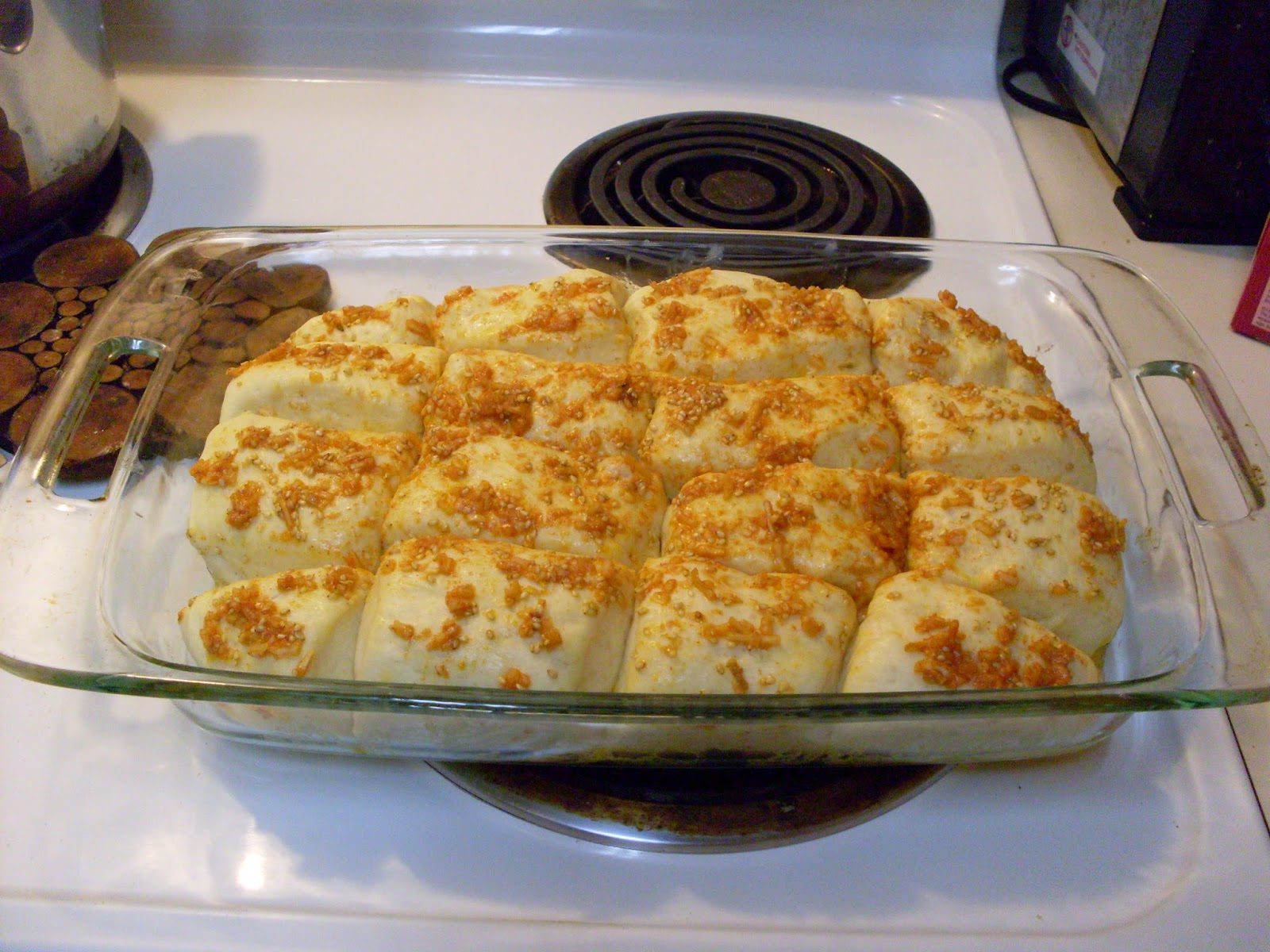
Before baking
 After baking

Pull Apart Onion Rolls
2 1/2 cups all purpose flour
1 pkg. dry yeast
1/4 cup milk
2 Tbsp. margarine(I used butter)
1 Tbsp. sugar
1/2 tsp. salt
1 egg
Onion Butter Filling:
2 tsp. Instant minced onion
2 tsp. water
3 Tbsp. melted butter
1 Tbsp. grated Parmesan cheese(I'm not a snob, I used the stuff from the can and it was just fine)
1 Tbsp. sesame seeds(mine were toasted)
1/2 tsp. paprika
1/4 tsp. garlic powder

In large mixer bowl, combine 1 flour salt and yeast. Set aside. In a saucepan, heat milk, margarine, sugar and salt, stirring constantly until butter is almost melted. Add to flour mixture. Add egg and beat at low speed for 1/2 minute, scraping sides of bowl constantly. Beat 3 minutes at high speed. By hand, stir in enough remaining flour to make a moderately stiff dough. Knead on floured surface until smooth and elastic. Place in greased bowl, cover and let rise until double. Punch down, cover and let rest 10 minutes. Roll dough into an 8-inch square. Combine filling ingredients and spread over surface of dough. Cut dough into 16 squares and place, filling side up, in a greased 1 1/2-qt. casserole.(I used a 9"x13" pyrex dish. I found that it was very difficult to lift the topped dough and place it into the dish without the melted butter mixture running all over the place. I cut it in the dish. I would recommend placing the dough in the dish first, then topping it, then cutting it. Or you could cut it and then spoon the topping over it. But get it in the dish first or you'll make a huge mess.) Cover and let rise until nearly double. Bake in 350 degree oven for 25-30 minutes(I did 25), covering with foil after first 15 minutes. Cool in dish 5 minutes, then carefully turn out onto serving platter. Serve warm.-Ruth Elliott-Viola

The rolls smelled really good going into the oven and I was surprised at how bland I found them when they'd baked. Maybe they needed more salt and Parmesan in the topping. That probably would have helped. Maybe if I'd sauteed fresh onions instead of using minced that would have helped too. Also, they were a little dry. I'm not sure if maybe I let them rise too much or in too warm of heat and it made them dry out, or what. I think they have potential though.

I was surprised at how not fishy the trout was. My apartment smells like herbs, not fish, which is really good. I might need to experiment with this fish more in the future. Sometimes it's hard though, when you live in salmon country, to branch out and try other fish. But fish is so good for you that I should probably make that effort. I served this with rice pilaf, and no vegetable because I was too lazy to make one. There's green stuff on the fish, that counts, right?

Sources:


Sunday, March 4, 2012

Cooking Light Roundup

This weekend I tried a couple recipes. Friday night I tried their suggestion for oven fries. I love oven fries but they always get overdone. Their suggestion was to soak them in water first and then drain them before going on as usual. So I did. They still got overdone, unfortunately, but I think I'm on the right track. I think they just cook for too long. Instead of a half hour I'll try 20 minutes and see how it is next time.

Saturday for lunch I tried making fish tacos. I need to eat more fish in my diet since it's so heart-healthy, so I tried an easy one. I bought some frozen tilapia fillets at the store and was a bit scared to use them. I don't usually cook fish so I am not very skilled at it yet. It's expensive, it smells for a long time after you cook it, and I'm a bit scared that it will taste really fishy. Well, this stuff didn't taste fishy, thankfully, but it did taste...oceany, if that makes any sense. It'll take a bit of adjusting but I think I'll get there.

The tacos were pretty good, especially since I figured out how to steam the soft corn tortillas with the basket from my rice cooker. The toppings were ok, not highly flavorful, but it is March, tomatoes and avocados are hardly at their peak right now. I think I need to try cabbage and green onions, it definitely needed something crunchy.

Here's the recipe: Blackened Tilapia Baja Tacos

Wednesday, January 18, 2012

Cooking Light Tuesday


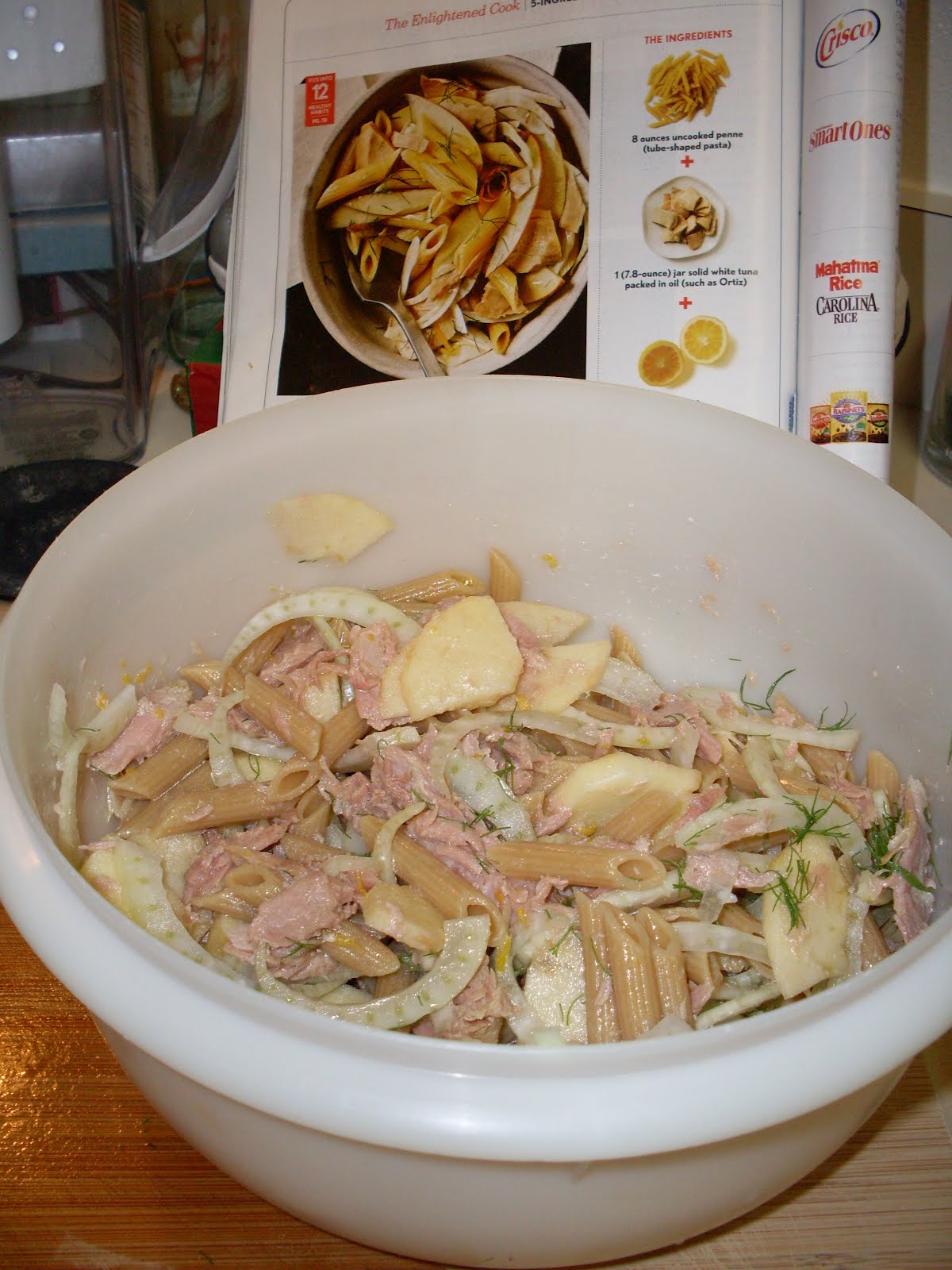
Well I was going to do my Cooking Light night on Sundays, but sometimes life gets in the way. And in this case, not feeling well on Sunday and a three day weekend got in the way. But, I did a recipe, just on Tuesday. Last night's recipe was Tuna-Fennel Pasta Salad. Until I actually read the recipe, which I still have the tendency not to do until just before making it, I thought this was going to be a hot dish, akin to Tuna Noodle Casserole. I was very much mistaken. So this was a side dish, but I thought it was quite tasty. I splurged, which is big for me, and bought a fancy glass jar of tuna from Italy. Boy was it worth the money. It was delish! I'd never use it for sandwiches, only for special dishes because of the cost. And I've never had fresh fennel before so I'm not sure exactly how it's supposed to taste, other than anise-like. But this stuff didn't have much flavor. I'm guessing January probably isn't fennel's peak season. But I wasn't too grossed out, so that's good, right? I have some potatoes I was going to roast, and maybe I'll throw the extra fennel into that and see how it works. The recipe was really simple, and I liked the combination of flavors. I'd definitely try this again, or maybe make it for a family gathering some time.

Here's the link to the recipe: Tuna-Fennel Pasta Salad